


01 / Regulatory overload
More requirements
CRA, AI Act, NIS2, DORA, MDR and IEC 62443 each bring their own deadlines, assessments and evidence requirements. Growing requirements worldwide increase the coordination work.
Built by GRC engineering experts. VamiGRC turns compliance into your competitive advantage.
From supplier to SBOM to a prepared notification for BSI and ENISA: VamiGRC brings NIS2, the CRA, the AI Act, DORA and ISO 27001 together in one system, all the way to certification. At its core is quantitative risk management: risks and measures valued in euros make the return on security and compliance investment (RoSI, RoCI) calculable at last. You prioritise, cost and plan measures together with the people who own the budget. AI agents handle the routine work with your approval, hosted on T Cloud Public in Germany.


ISMS
An ISMS manages information security as a continuous cycle: set the scope, assess and treat risks, select controls and justify them in the Statement of Applicability (SoA), then check their effectiveness in internal audits and management review.
Read more belowRegulations
Standards & frameworks
In the integrated management system
PIMS
A PIMS governs the lawful processing of personal data and makes it demonstrable. It covers the record of processing activities (RoPA), data protection impact assessments (DPIA), processor agreements, international transfers, data subject requests and data breaches, each with clear owners.
Read more belowRegulations
Standards & frameworks
In the integrated management system
AIMS
An AIMS governs how AI is developed, provided and used: AI inventory, risk classes, provider or deployer role, impact assessments, AI literacy, human oversight and monitoring. ISO/IEC 42001 gives it structure but does not by itself demonstrate AI Act conformity.
Read more belowRegulations
Standards & frameworks
In the integrated management system
CSMS
A CSMS anchors security in connected products and their software across the lifecycle: threat modelling from design onwards, secure development, SBOMs, vulnerability handling and disclosure, security updates and reporting. CRA reporting obligations have applied since September 2026.
Read more belowRegulations
Standards & frameworks
In the integrated management system
BCMS
A BCMS keeps critical processes running through disruption and restores them in a controlled way. Business impact analysis (BIA) and risk assessment set recovery targets; strategies and plans define the response, a crisis team steers it, and exercises and tests show the plans work.
Read more belowRegulations
Standards & frameworks
In the integrated management system


Intelligent risk management on one knowledge graph, the GRC Graph, for NIS2, the CRA, the AI Act, ISO 27001 and ISO 42001. AI agents assess risks, gather evidence and draft reports. Your experts approve.
The video loads from YouTube (Google) only after you click play. Privacy policy
IT security and compliance without AI is a vulnerability.

Growing regulatory demands, manual work and separate systems consume time. The connections between risks remain hard to see.
01 / Regulatory overload
CRA, AI Act, NIS2, DORA, MDR and IEC 62443 each bring their own deadlines, assessments and evidence requirements. Growing requirements worldwide increase the coordination work.
02 / Operational overload
Risk assessments, questionnaires and gap assessments often require manual work. This puts pressure on CISOs, DPOs, AI officers and their teams, delaying risk decisions.
03 / Disconnected silos
Separate tools and data models for ISMS, AIMS, PIMS, BCMS and CSMS make oversight difficult. Risks arising from their dependencies are often identified late.
VamiGRC brings these tasks into a shared management system.
Shared GRC processes
Shared data
Maintained once: consistent and free of redundancy across all five management systems. Information SecurityISMS · ISO 27001 · NIS2 PrivacyPIMS · GDPR · RoPA AI ManagementAIMS · EU AI Act · ISO 42001 Product / Cyber SecurityCSMS · CRA · IEC 62443 Business ContinuityBCMS · ISO 22301 · DORA
SHARED PROCESSES · SHARED DATA · ALL LENSES
The GRC Graph links assets, processes, suppliers and controls. Risks derived from these relationships are quantified in euros and prioritised in one view.
Risk Intelligence connects assets, processes, projects, suppliers, regulations and controls. Five governance lenses show how their relationships create critical business risks.
Every asset, process, project, supplier, risk, regulation and control — with all their relationships. Five governance lenses (ISMS, AIMS, PIMS, BCMS, CSMS) overlay the same authoritative graph and surface toxic combinations that stay invisible in spreadsheets. We call the result Risk Intelligence: risks are derived across assets, suppliers, data and projects via the graph — down to the single business-critical risk.
Connected inventories: business processes · processing activities · AI use cases · information & data · assets · suppliers · people & accounts · domains & ASM · risks · controls · evidence — plus products and projects.
The consolidated dashboard combines security and compliance risk from five management systems. Consistent assessments give management a shared basis for decisions.
Individual management systems often use different scoring methods, taxonomies and refresh cycles. VamiGRC combines the five risk views in a consistent management interface so leadership can prioritise security and compliance risk on the same basis.

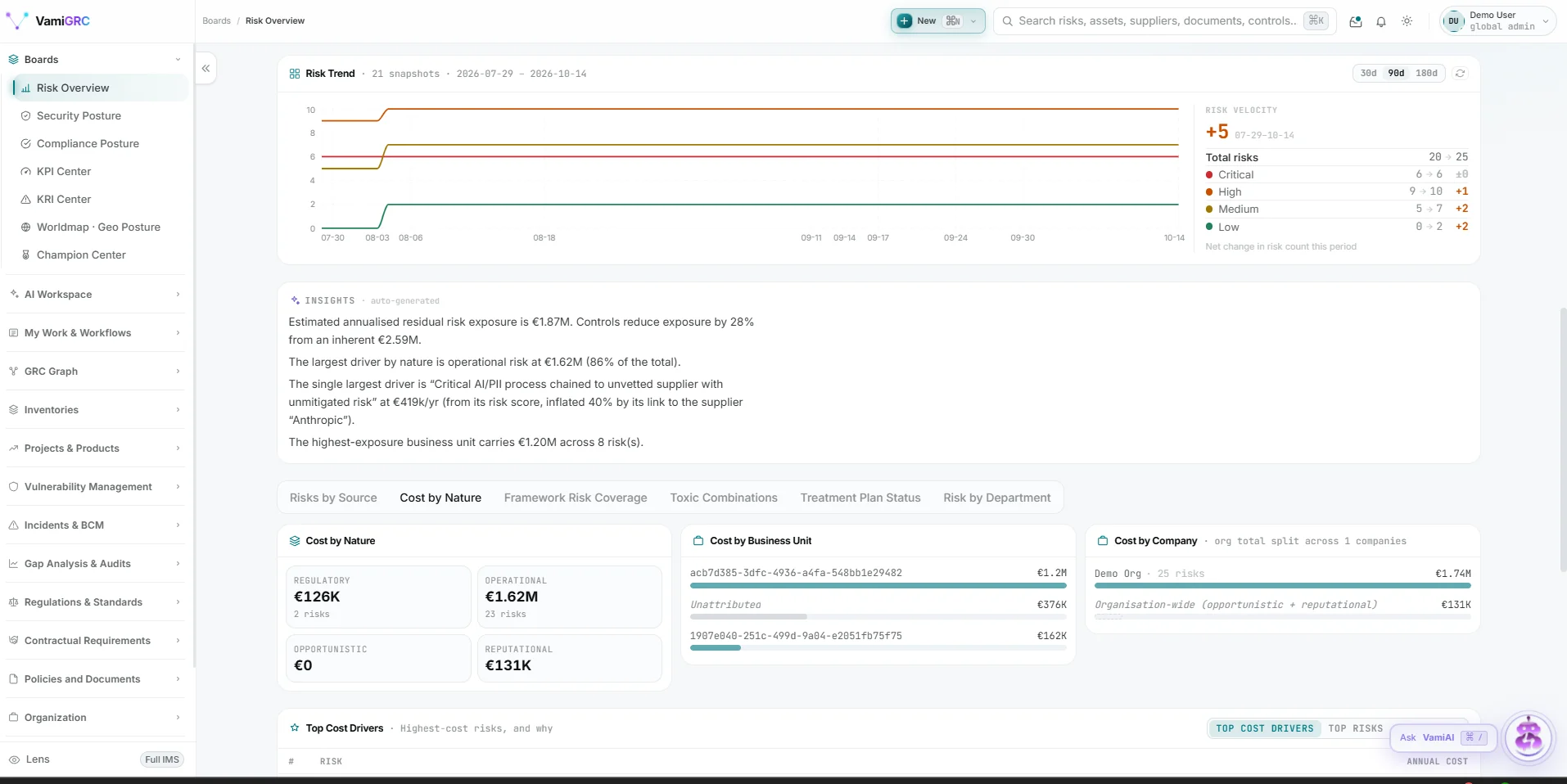
VamiGRC calculates annualised financial exposure per business unit. The model combines your company profile, BIA and regulatory requirements, with calibration that finance can review.
Inherent and residual risk are expressed as annualised financial exposure per business unit. Inputs include the company profile, BIA results, applicable regulations and potential fines. An adjustable master factor lets finance review the assumptions. Results are available in euros and dollars.
Every quarter the CFO gets a single number per BU — comparable to other operational risks. Investment decisions become defensible against a peer-benchmarked baseline.
Implementing a control reduces the LM (loss magnitude) of every linked risk automatically. The €/$ savings of each control investment are visible — ROI on compliance, not just cost.
"What if NIS2 fines double?" "What if we open in Singapore?" "What if Anthropic loses its DPA?" — model it in seconds, see the new monetary exposure across all BUs before the call ends.
A heatmap and annualised exposure show risk in qualitative and financial terms. Compare inherent and residual risk using a FAIR-aligned approach built around ISO 31000.
The risk dashboard shows where the organisation’s risk actually sits — qualitatively as a heatmap and quantitatively as annualised exposure in euros, FAIR-aligned and built around ISO 31000. Inherent and residual risk sit side by side.
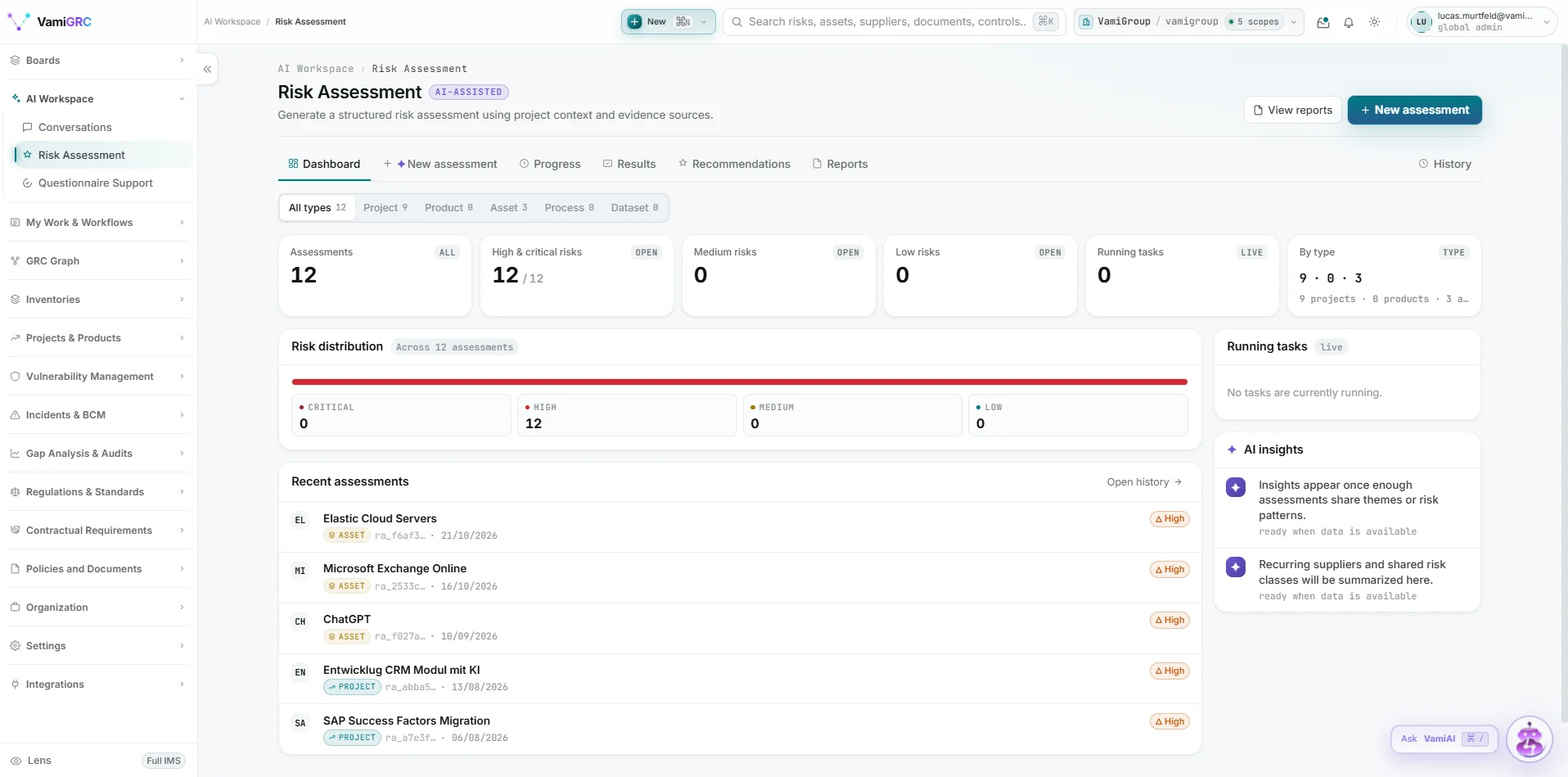
VamiAI turns a project description and evidence into a structured risk register, including ratings, residual risk and a management summary.
From a project description and uploaded evidence, VamiAI produces a structured risk assessment: key risk themes, overall risk, individual risks with likelihood, impact and residual rating — plus a management summary you can forward as is.
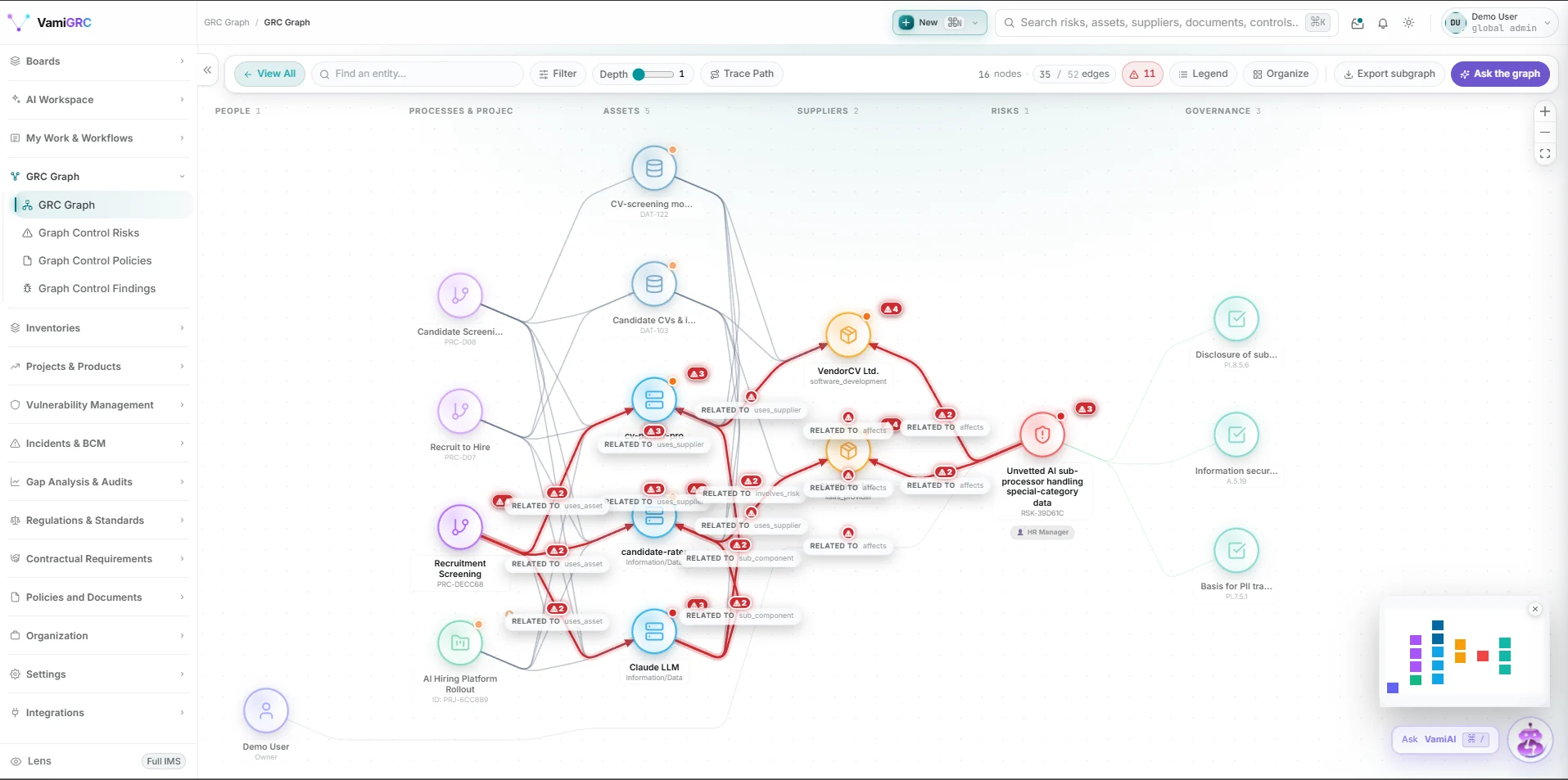
This example shows how personal data, high-risk AI obligations, supply chains and missing controls combine. The graph makes the resulting business risk traceable.
Risk Intelligence derives risk from relationships between assets, suppliers, data and projects. The recruitment screening example connects GDPR Article 9, high-risk EU AI Act obligations, an AI provider supply chain and unimplemented controls. Together they create a critical business risk that can be traced in the graph.
↓ one process · three lenses · one source of truth ↓
Recruitment screening is a single record in the Business Process Register — but because it processes special-category personal data and uses an LLM, the same record is automatically read as a RoPA Art. 9 entry (PIMS) and a high-risk AI Use Case under Annex III (AIMS). One row. Three lenses. Zero copies.
The asset is Claude. The risk doesn't come from Anthropic — it comes from a marketplace Claude Skill built by a third party. A second supplier in the chain that most asset registers don't capture. Tier-1 looks clean. Tier-2 carries the actual risk.
Cross-domain decisions on special-category data, processed by an LLM via an unaudited third-party Skill — with the originating risk unmitigated and the covering controls not implemented. Each silo sees one piece. Only the graph sees the whole.
VamiGRC's Supplier Intelligence Module ran continuous OSINT enrichment, breach monitoring and questionnaire automation against the marketplace Skill authors — and surfaced high-risk findings for both VendorCV Ltd. and SkillsRater Inc. before any human looked. No DPA in place. No security certifications. Sub-processors undisclosed.
"Three management systems were each looking at the same Recruitment process. Only the graph saw it as one risk."
Manufacturers and operators are often subject to several regimes at once. These scenarios show how VamiGRC brings them together.
One control set for NIS2 and ISO 27001 at company level, release gates and SBOMs for controllers and software, and one place for both reporting paths.
Reporting deadlines, business continuity plans and OT suppliers in one graph, with evidence ready for audits.
Product risks, SBOMs and post-market obligations together with the ISMS, so product and company security work from the same data.
Wiz connects cloud resources and attack paths. VamiGRC applies this principle to processes, assets, suppliers, controls and compliance risk to reveal critical risks to your crown jewels.

Connects assets, vulnerabilities, identities and network paths to identify combinations that put critical cloud resources at risk.
Connects controls, risks, processes, regulations, assets and evidence to reveal dependencies across governance domains.
VamiGRC · GRC Graph · live tenant
Member · Wiz Partner Alliance · 2026
Role-based lenses, group structures with their subsidiaries, locations with their data flows and connectors to your existing systems.
A lens adjusts terminology, modules, KPIs and filters to your role. Switch at any time, or ask VamiAI to recommend a view.

The Lens reshapes the entire dashboard — terminology, modules, KPIs, default filters — to match your role. Switch any time. Selection persists per session. VamiAI can recommend a Lens based on your role & recent activity.
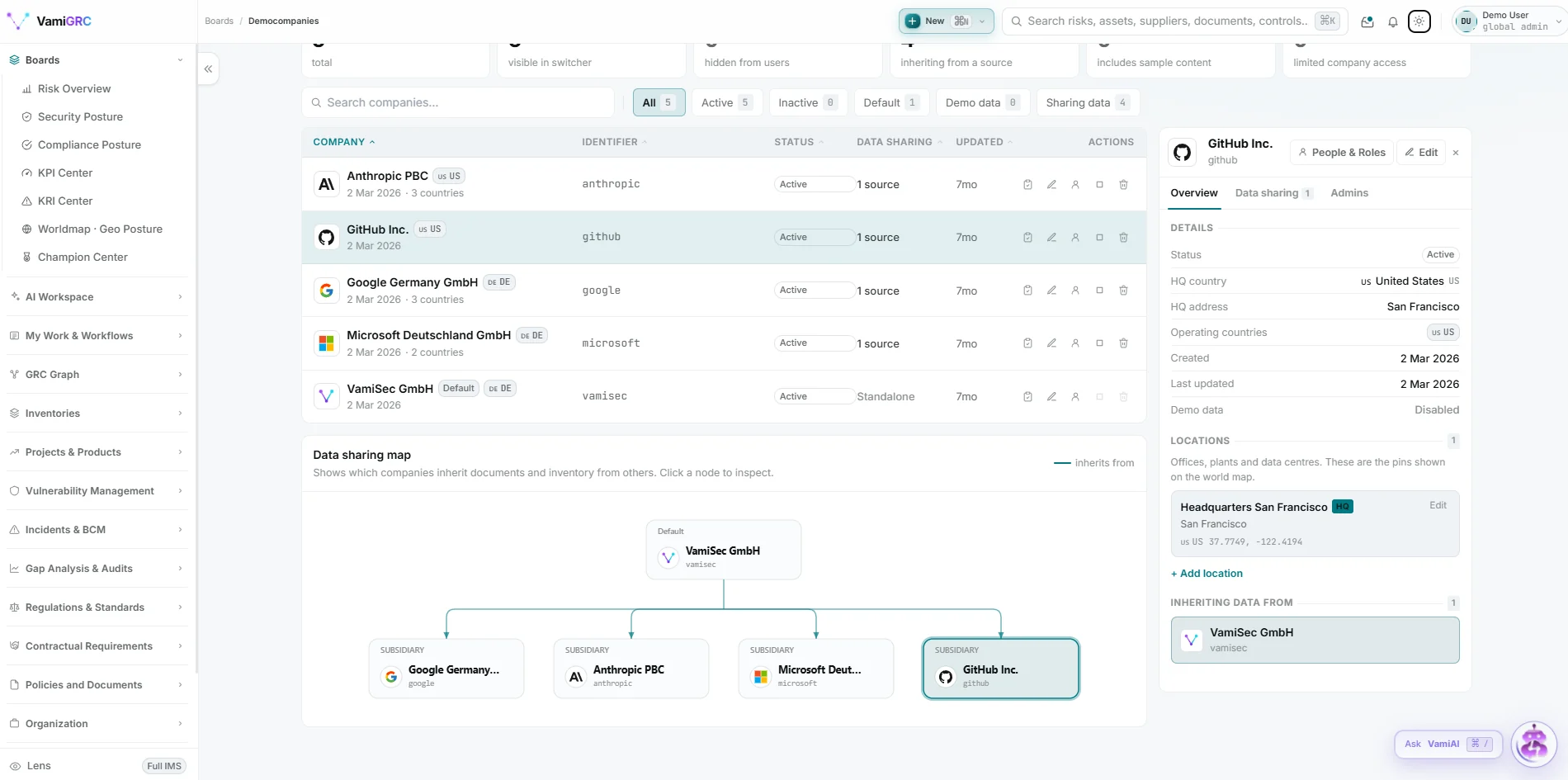
Manage the holding company, subsidiaries, country entities and sites in one tenant. Each entity retains its governance and inherits group requirements.
Holding, subsidiaries, country entities and sites live in a single tenant — each with its own governance, each inheriting what the group defines. No second system, no spreadsheet reconciliation between sites.
The map connects locations, assets, suppliers, people and data residency. Regional views show cross-border transfers, adequacy decisions, SCCs and BCRs.
Live geographic view of locations, assets, suppliers, data residency & people. Cross-border flows render as animated arcs · pulse markers indicate hubs · per-region drill-down with adequacy / SCC / BCR overlays.

Connectors import data from cloud, identity, version control, endpoint, awareness, OSINT and task management systems. Inventory records link to owners, assets and controls.
Cloud, identity, version control, endpoint & awareness, OSINT and task management hang off the same graph as connectors. Every sync lands as an inventory row — linked to owner, asset and control.
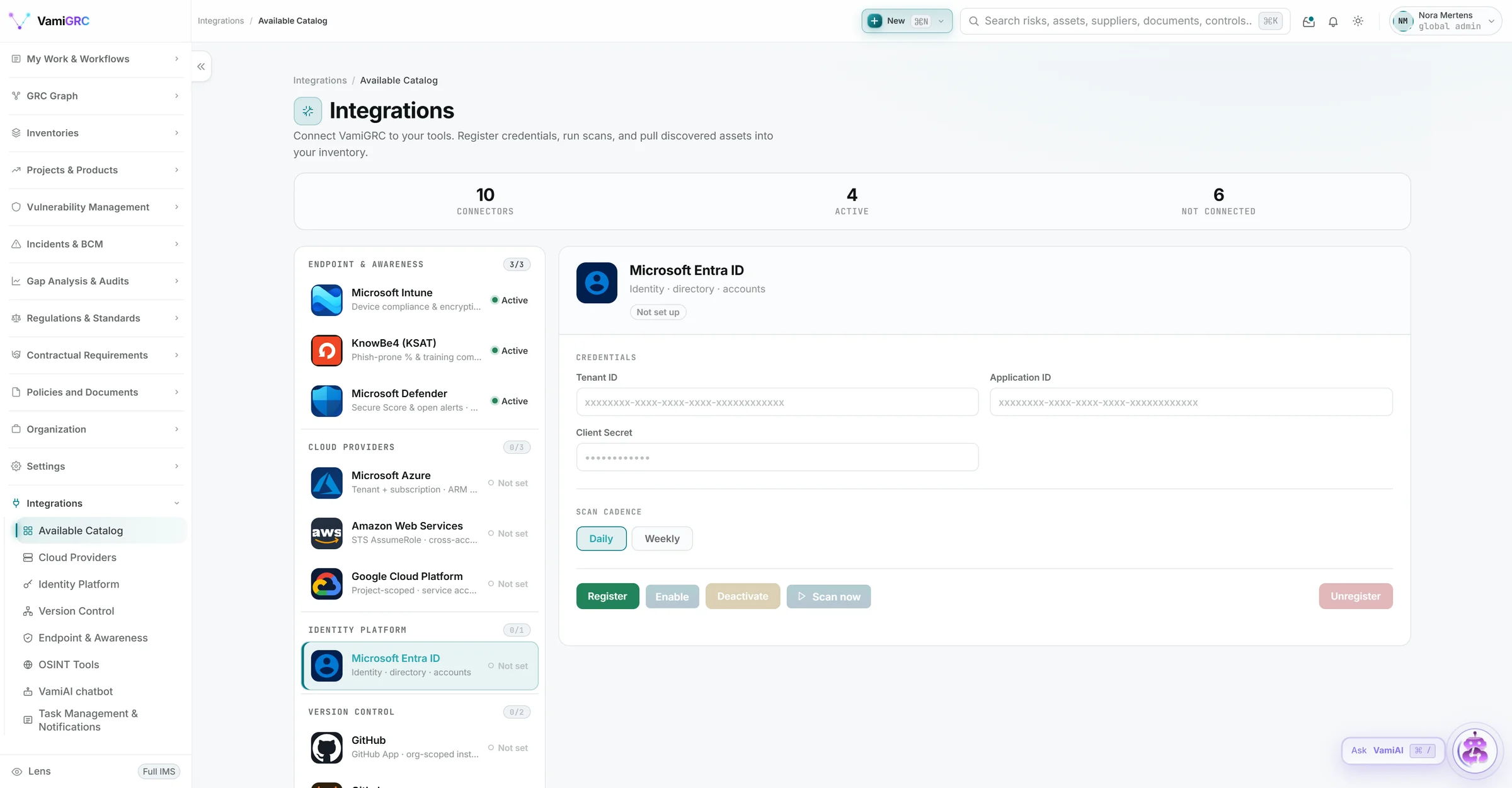
VamiAI is a personal assistant for all employees: ask questions, draft assessments, run workflows and manage tasks, directly in Microsoft Teams as well. This democratises GRC across your organisation. Autonomy levels L0–L3 define what runs automatically and what needs approval.
 Available in Microsoft Teams
 VamiGRC connector
VamiAI uses your IMS, GRC Graph and active frameworks to answer questions, analyse data and execute tasks. Your L0–L3 autonomy policy controls approval for changes.
The assistant uses your IMS data, GRC Graph relationships and active frameworks as context. It can query data, analyse findings, draft documents and execute actions. Every write follows the configured L0–L3 autonomy policy and its human approval requirements.

VamiAI supports CISOs, DPOs, AI officers and employees on every VamiGRC page and through Microsoft Teams, Slack, email, mobile and browser. It answers questions, executes tasks, explains policies and highlights relevant graph risks.
Employees can address security and compliance questions in the channels they already use. This makes support easier to access and reduces work for specialist teams.
Microsoft Teams
 Slack
Email
Mobile · iOS / Android
Browser
Every page · in-app
Cited answers from policies, processes, evidence and standards across ISMS, AIMS, CSMS, PIMS, BCMS. Multi-language. Strict grounding in your sources — every statement carries a citation; unsupported answers are refused rather than guessed.
Translates plain language into precise graph traversals. Aggregations, top-N, gap analyses, what-if simulations — answered in seconds with the underlying query visible for transparency.
Triggers risk analyses, supplier evaluations, gap analyses, pentests, threat modelling, audit kick-offs — all from natural language. Every destructive action requires explicit confirmation. Audit log captures every step.
Delegates tasks to VamiRedteam, VamiThreat, VamiAudit, VamiAppSec and VamiGuard. Each agent handles a defined area of GRC and IT security work.
Employees ask VamiAI in plain language and get answers from your own IMS, with the underlying documents referenced. GRC becomes accessible across the whole organisation, not just in the compliance team.
Microsoft Teams
Slack
REST · MCP API
Voice · iOS / Android

Claude doesn’t just answer questions about your GRC programme – it works in it. It finds gaps, drafts risks and controls, logs incidents and vulnerabilities, links records and creates follow-up tasks. No tab switching, no exports, no copy-paste.
Get started: Claude → Settings → Connectors → search “VamiGRC” → connect and sign in with your VamiGRC account.
Most GRC platforms are databases with a chat layer bolted on. VamiGRC is built around real automations and agentic workflows that operate at four well-defined autonomy levels — adapted from OWASP APTS for the GRC domain.
Risk re-assessments · supplier reviews · gap analyses · evidence collection · KPI roll-ups — orchestrated end-to-end across systems, not collected on a clipboard.
VamiRedteam · VamiThreat · VamiAudit · VamiAppSec · VamiGuard — each a domain expert. VamiGRC orchestrates them through one conversation.
Natural-language access to every control, risk, process, asset and evidence — audit-logged · role-scoped · citation-bound. Every answer points to its source.
Every write operation falls into a defined autonomy level. No silent automation. Always auditable, with logs that support the record-keeping duties of the EU AI Act for high-risk systems.
Two-key approval on critical changes · pause-and-revert at any L3 step · always-on red-button to escalate to a human reviewer. Owner-of-record on every agentic decision so the audit trail holds in court.
VamiAI surfaces what you didn't ask: emerging gaps, expiring evidence, drifting controls, new regulations affecting your sector. Suggests next steps with reasoning and citations, like a senior compliance officer sitting next to you.
Every prompt, tool call, decision and write operation logged with timestamps, model version and reasoning trace.
Audit trails support the EU AI Act Art. 12 record-keeping duties for high-risk systems. Exportable for regulators.
L2 enforces mandatory human approval. L3 can be paused, reviewed and reverted at any time.
Connect triggers, conditions and actions in the workflow builder. VamiAI can handle individual steps, with approvals and execution history included in the process.
The visual workflow builder connects triggers, conditions and actions — and attaches VamiAI to any step. That is how you create your own agents that automate GRC processes end to end instead of merely documenting them.
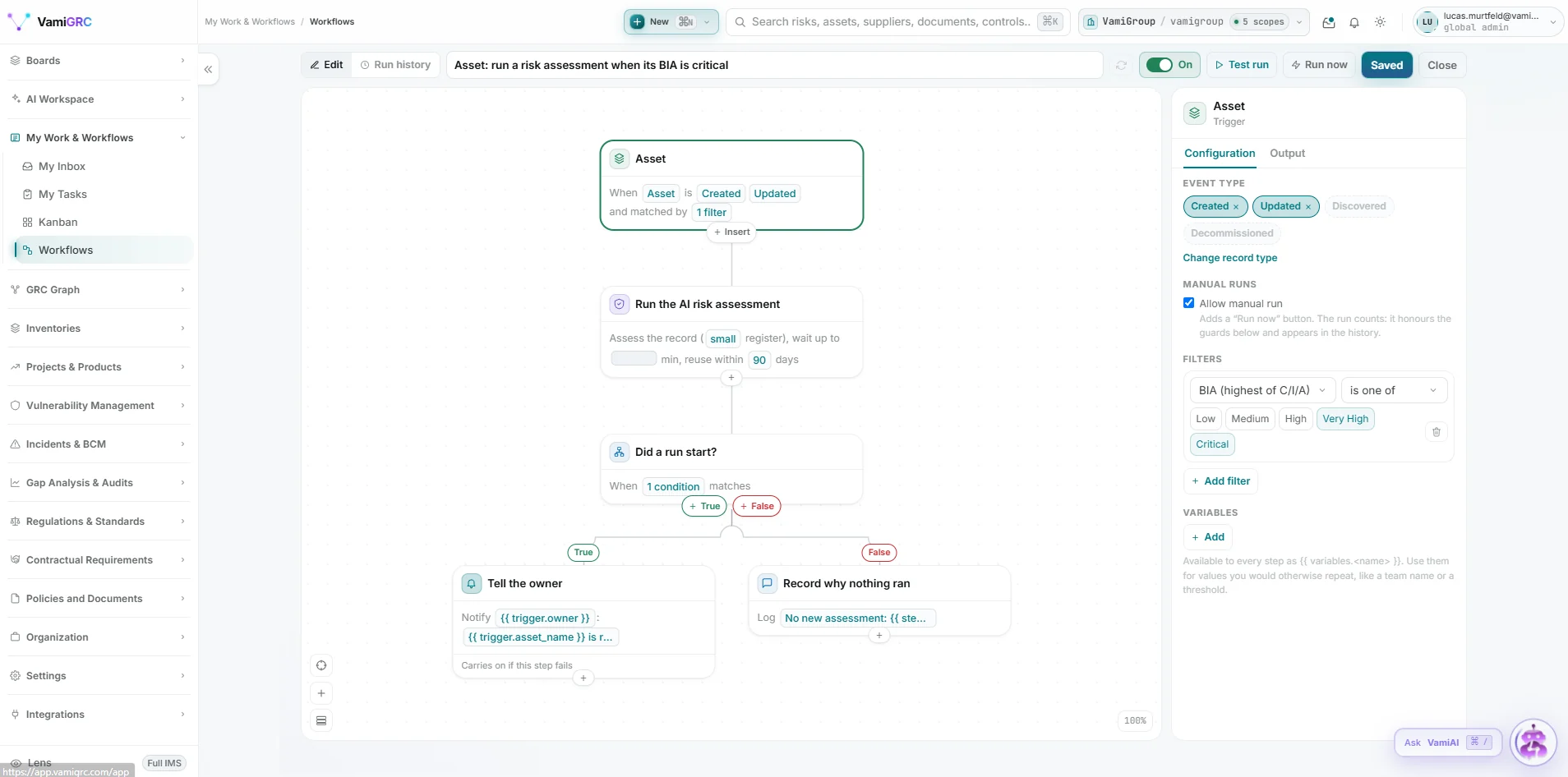
Audit findings, gap assessments, IMS activities, IAM reviews and supplier assessments generate tasks in one engine. The autonomy level controls execution, approval and evidence.
Audit findings, gap analyses, IMS calendar activities, IAM reviews, supplier assessments — every action lands in the same task engine. Each task runs at its configured autonomy level. AI agents execute, humans approve, evidence gets attached.
Define columns, statuses and fields for your workflow. Move tasks with drag and drop, from HR onboarding to pentest remediation.
Tasks move between columns by drag and drop — and you design the boards yourself: columns, statuses and fields match your process, not the other way round. From HR onboarding to remediating findings after a pentest.
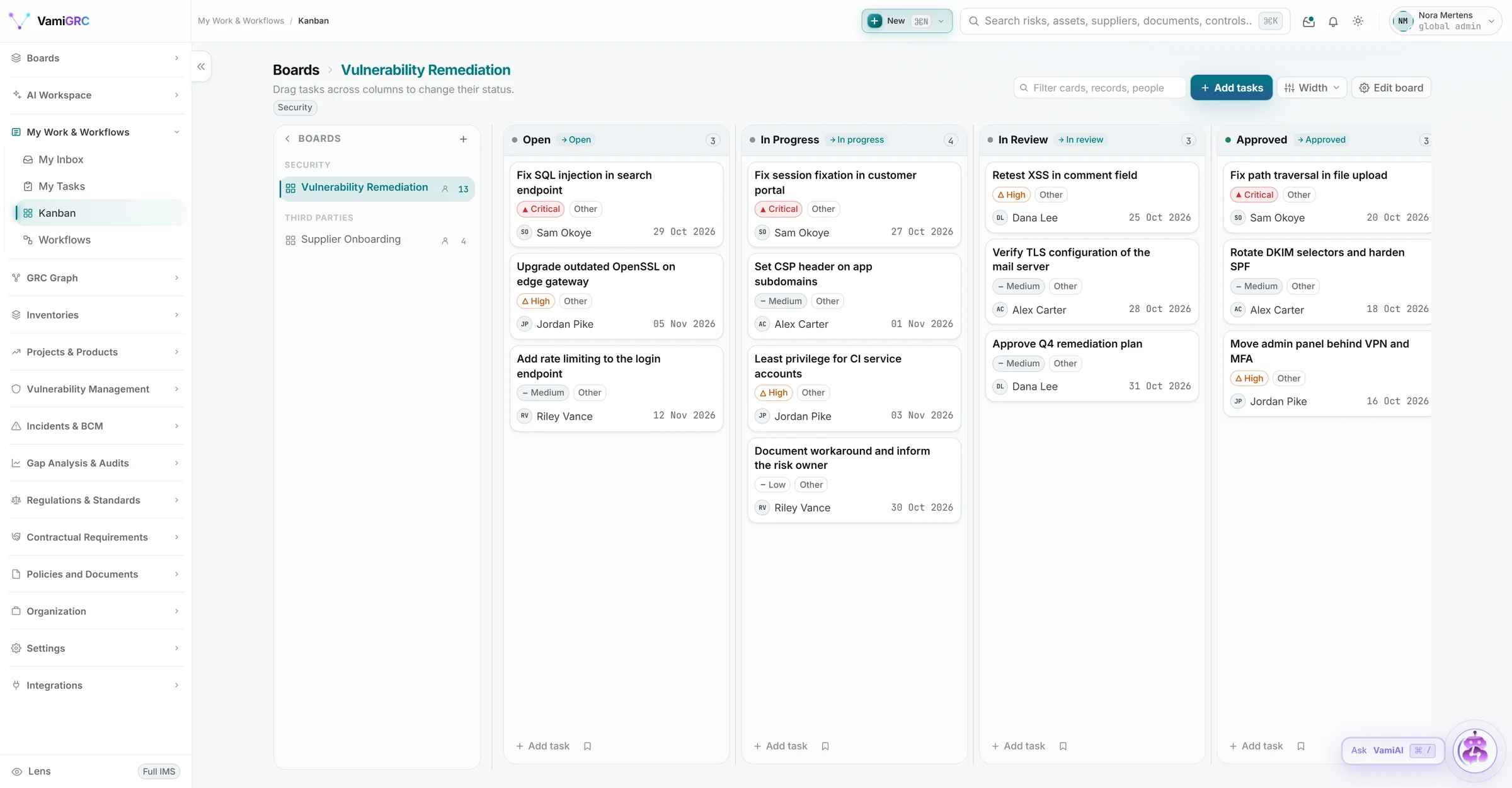
The full agentic workflow on mobile. Approve risk-treatment decisions on the way to a board meeting. Acknowledge incidents from a train. Pre-answer a CAIQ from your phone. Same graph · same VamiAI · same audit log — touch-optimised.
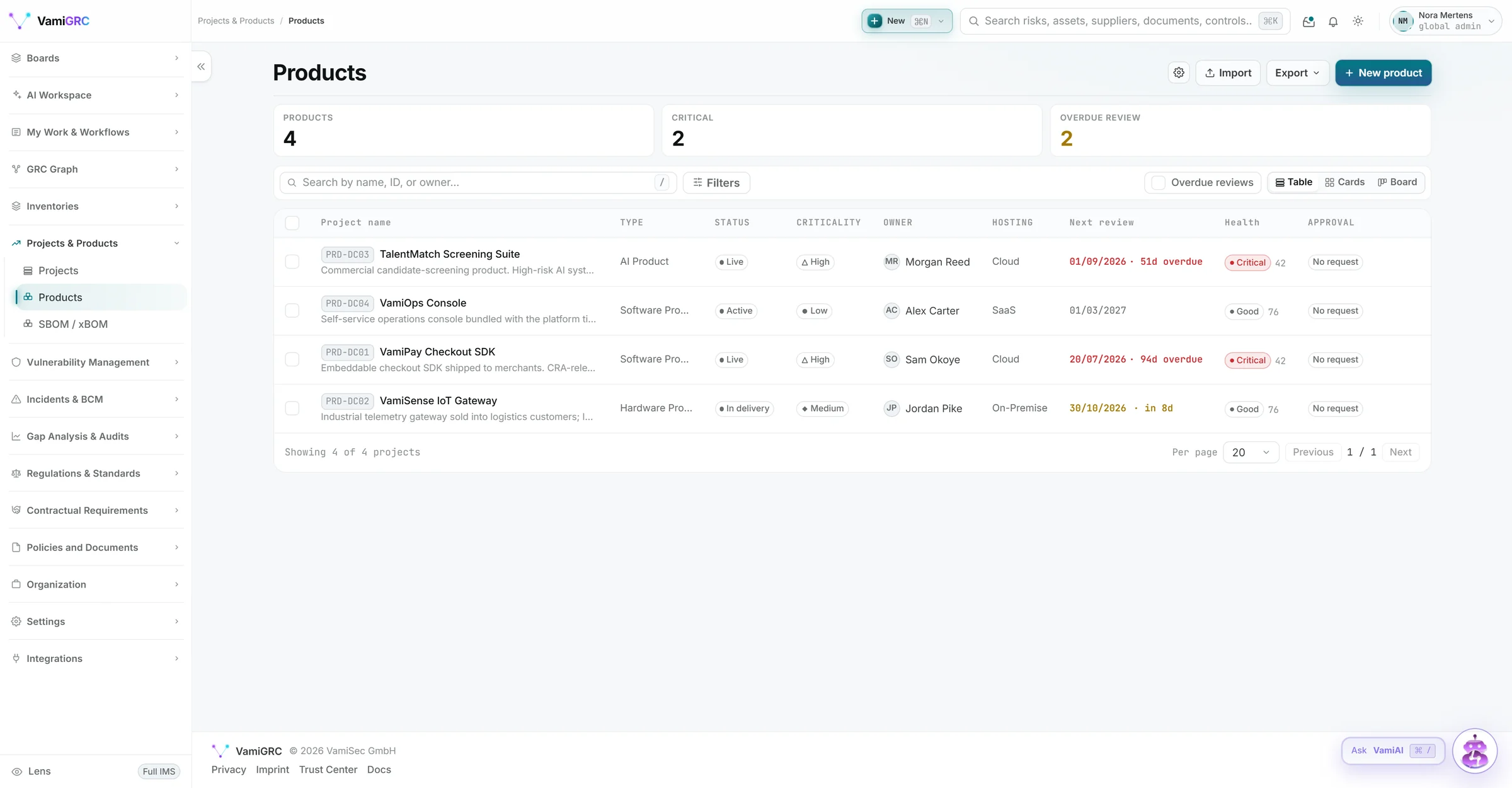
Projects and products pass defined gates. SBOMs, vulnerability handling and reporting paths under the CRA, IEC 62443 and the MDR are tied to the right phase.
Start the CRA readiness checkThe product security lifecycle extends your project workflow for CRA and MDR. VamiAppSec secures the CI/CD pipeline; VamiThreat supplies threat models, risk assessments and mitigations for the security concept.
A full Product Security Lifecycle layered on top of your project workflow — VamiAppSec hardens the CI/CD pipeline (SCA · SBOM · SAST · DAST), VamiThreat drives threat modelling (STRIDE for classic apps · MAESTRO for agentic AI). Both feed automated risk analyses and mitigation measures straight into the security concept and the GRC Graph.
A turnkey security CI/CD pipeline plugged into the VamiGRC PSL. Every build runs SCA, SBOM generation, SAST and DAST gates — failed gates block release; passed gates ship evidence into the GRC Graph automatically.
Two threat-model recipes, picked automatically by product type. STRIDE for classic application architectures · MAESTRO for agentic AI landscapes. VamiThreat runs the analysis, scores risks, and writes mitigation measures back into the security concept.
Eight phases run from Govern to End-of-Support. Release gates based on IEC 62443-4-1 connect framework mappings with CRA, MDR, RED and ISO/SAE 21434 requirements.
The Product Security Lifecycle takes every product through eight phases — from govern to end-of-support — with defined release gates. Anchored in IEC 62443-4-1 with cross-walks to SSDF, MS-SDL and IEC 81001-5-1, and with compliance overlays for the CRA, MDR, RED and ISO/SAE 21434.
A component graph connects nine BOM and evidence types using CycloneDX 1.6 and SPDX 3.0. Signatures, timestamps and a transparency log document provenance and approval.
A single Component-Graph holds SBOM · SaaSBOM · AI-BOM · CBOM · HBOM · OBOM · MBOM · VDR · VEX as structured records — each with its own schema and workflow, all queryable as views over the same data. Built on CycloneDX 1.6 + SPDX 3.0. Signed with cosign / Sigstore Rekor, time-stamped with RFC 3161. Sign-off hash-chain anchored to a public transparency log. Ready for CRA Annex I + Art. 14, MDR, FDA §524B, ISO/SAE 21434, UNECE R155, IEC 62443-4-1, EU AI Act Annex IV.
Libraries · dependencies · packages · transitive components. PURL canonical IDs · evidence + confidence per identification · multi-engine license merge.
Cloud services · external APIs · endpoints · data-flows · subprocessors. Surfaces the dependency tree most SBOMs miss.
Models · training datasets · frameworks · inference pipelines · prompts · model cards. Lineage from your MLOps registry · EU AI Act Annex IV docs.
Algorithms · keys · certs · protocols. Mapped to BSI TR-02102 · NSA CNSA 2.0 · NIST PQC. Post-quantum migration heatmap on every release.
Chips · PCBs · firmware refs · BOM-lot tracking. ERP/PLM sync (SAP · Oracle) · UDI-linked for MDR · counterfeit-detection signals.
Containers · runtimes · configs · secret references. Live runtime drift monitor — image-digest vs. BOM expectation, AI auto-classifies known rollbacks.
Parts · suppliers · Lot-IDs · physical assemblies. PLM-driven · feeds the HBOM lineage when the chip ships.
Per-release snapshot of the VEX stream. Generated automatically on release · signed bundle · 10-year retention per CRA Art. 13(8).
4 statuses · not_affected · affected · fixed · under_investigation · with the 5 standardised not_affected justifications. Drafted by VamiAI from call-graph reachability + advisory.
provenance.slsa_level)Project intake classifies regulatory scope, BIA and AI risk. Baseline controls, owners and approvals follow each phase from the initial idea to decommissioning.
Every project from idea to decommissioning passes a structured intake that auto-classifies regulatory scope, BIA and AI risk class — then assigns the right project-type-specific baseline controls (SaaS, Cloud Migration, Custom Development, Power Automate, AI Project) and the right owners to the right phases.
Data classification, personal data, DPIA, AI risk class and BIA determine project requirements. InfoSec, privacy and AI compliance review and approve within the project.
Every project carries its security and compliance requirements with it: data classification, personal data, DPIA obligation, AI risk class and BIA criticality. The approval process by InfoSec, data protection and AI compliance lives inside the project — not in a separate ticketing tool.
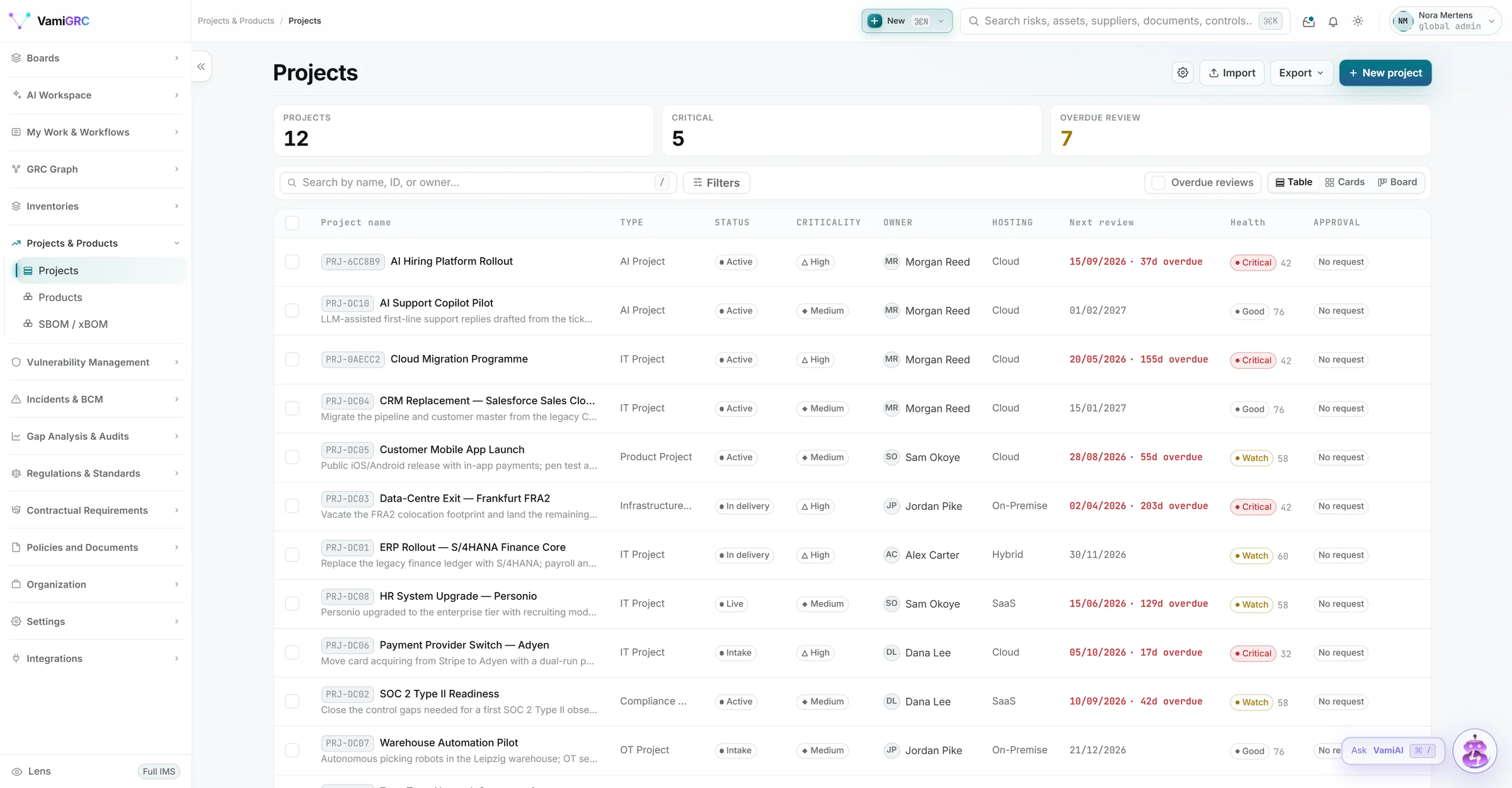
AI agents assess your suppliers automatically: technical analyses via OSINT, compliance assessments from publicly available information such as suppliers' trust centres and, for particularly important suppliers, semi-automated questionnaires from the bundled questionnaire catalogues. Your team reviews and approves the results.
Six VamiAI supplier agents handle onboarding, assessment, monitoring, compliance checks, reporting and remediation across IT service providers, cloud and AI suppliers, data processors and software components. Results feed the supplier inventory, risk register, BCMS and GRC Graph.
Unified TPRM across IT service providers · cloud (CSA CCM v4.1) · STAR · AI suppliers (Provider/Deployer per AI Act) · GDPR processors (Art. 28 DPA) · software supply chain (CycloneDX XBOM: SBOM/SaaSBOM/AIBOM/CBOM/HBOM/VEX). Cascades to Risk Register · Suppliers Inventory · BCMS · GRC Graph.
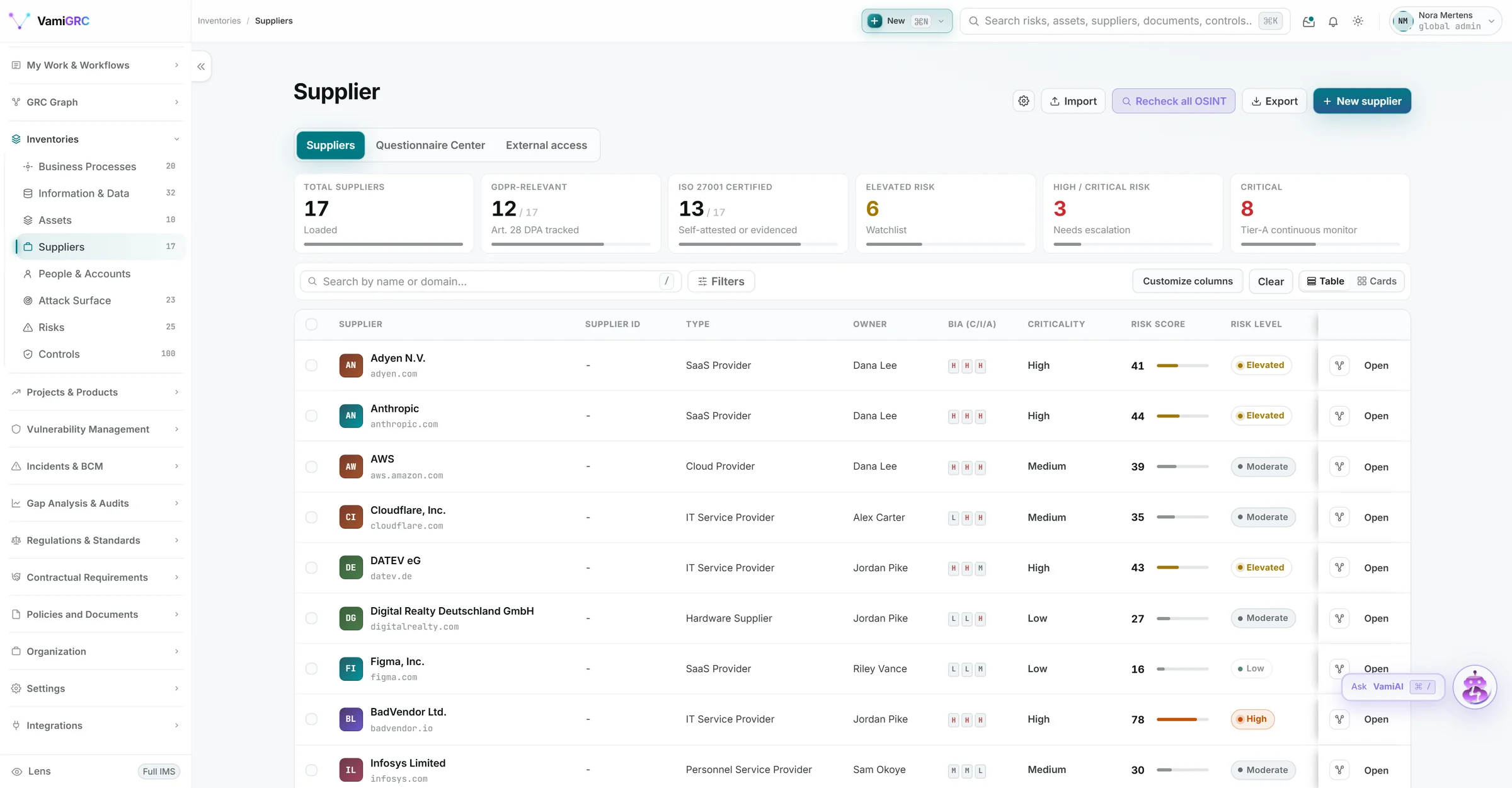
Every supplier's criticality is computed automatically from connected business processes, the data classes they touch, the service categories they support, and the information assets they enable. Change a process owner or upgrade a data classification — supplier tier re-flows in real time, no questionnaire required.
Why it matters: tier-1 status drives DPA depth, audit-rights frequency, BIA inclusion and BCMS recovery priorities — getting it wrong costs months. Derived criticality keeps it correct continuously.
For most suppliers VamiGRC builds the assessment without involving the supplier — pulling Trust Centers, CSA STAR Registry CAIQ submissions, sub-processor lists, breach feeds and OSINT signals into a draft assessment that's ready before the procurement call. Only high-risk vendors get a tailored questionnaire — and even that one is pre-filled with everything we already know.
VamiGRC automatically reviews OSINT sources and public trust centres. The BIA determines criticality, tier and assessment depth for each supplier.
OSINT analysis and public trust centre reviews automatically provide an initial supplier risk score before questionnaires are sent. The BIA determines criticality, tier and depth for the subsequent assessment.
AI-Powered Intelligent Document Processing for customer & partner contracts.
Upload the contract. VamiGRC extracts every security & compliance requirement, classifies them by type (data protection · SLA · audit-rights · subcontractor · cross-border · breach-notification), maps them to your IMS controls, tracks SLAs, identifies gaps — and triggers agentic workflows when something drifts.
VamiGRC extracts security and compliance requirements from contracts, classifies them and maps them to IMS controls. Track SLAs, gaps and changes through workflows.
The supplier contract wizard derives security and compliance clauses from the project. It updates your templates or creates a separate addendum, with an optional eIDAS-compliant signature workflow through to countersignature.
Every project surfaces a list of security and compliance requirements — from data classes, AI use, sector regulations and customer obligations. The Wizard pulls in your existing templates — Rahmenverträge / MSAs, Projektverträge, Freelancer-Verträge, NDAs, Werkverträge, DPAs, SaaS-Agreements — and either injects the missing clauses directly into them or generates a standalone Security & Compliance Addendum when nothing is in place yet. Optional eIDAS-compliant e-signing flow built in — so when there is no binding contract yet, the Wizard takes it from draft to countersigned in one workflow.
Picks the right clauses based on the project's data classes, AI use, sector, geography and customer obligations — no manual triage.
Works with the templates you already have — Rahmenvertrag, MSA, Projektvertrag, Freelancer, NDA, Werkvertrag, DPA, SaaS — house style preserved, redlines visible.
eIDAS-compliant e-sign flow built in (QES · AES · SES) for when there is no binding contract yet — counter-signed and audit-trail logged into the IMS in one step.
When a regulation changes or a customer obligation tightens, VamiAI flags the existing supplier contracts that need an addendum update — with the exact clause delta.
Determine the applicable requirements, merge them into one control set and keep coverage across all frameworks up to date.
22 Tier-1 regulations + standards + frameworks (per VanZee Tier Classification 2026), plus your company-selected obligations. Implement once · comply many times — easily mapping live coverage from ISMS · AIMS · BCMS · CSMS evidence.

The framework composer combines overlapping requirements from standards and regulations, including ISO 27001, NIS2, CRA, ISO 42001 and the EU AI Act. Implement and maintain the resulting controls together.
The Framework Composer merges any standards and regulations into one unified control set — for example ISO 27001 + NIS2 + CRA + ISO 42001 + the EU AI Act. Equivalent requirements are combined instead of implemented five times over: fewer controls, less redundancy, less effort in implementation and operation.
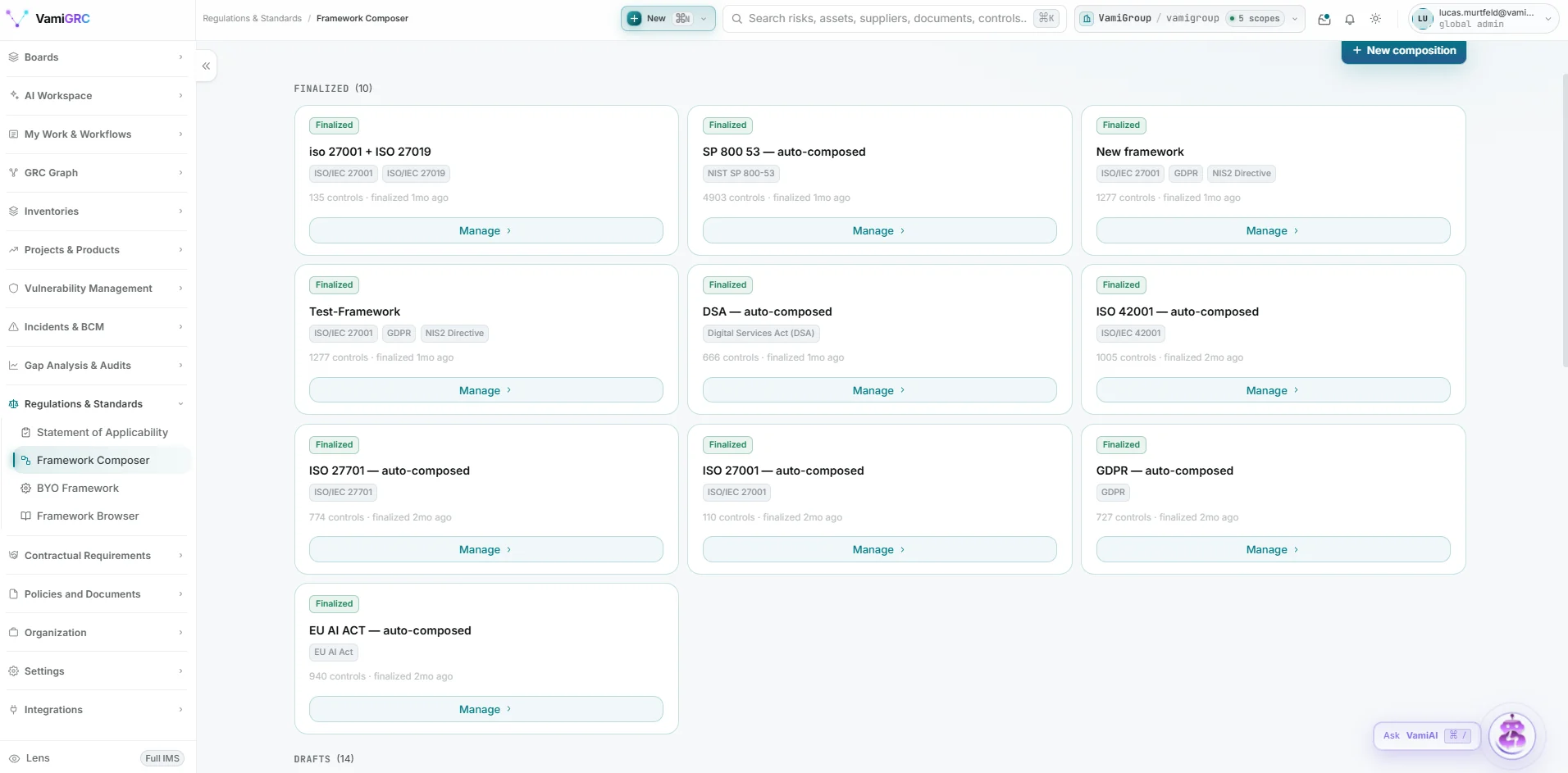
VamiGRC represents regulations, standards and frameworks in NIST's Open Security Controls Assessment Language. Controls and evidence are machine-readable in XML, JSON or YAML.
The NIST-led Open Security Controls Assessment Language is our backbone. Every regulation, standard and framework is expressed as machine-readable XML / JSON / YAML. No more copy-paste between Word documents and spreadsheets. Audit cycles measured in days, not months.
ISO 27001:2022 · ISO 42001 · ISO 27701 · ISO 22301 · NIS2 · DORA · EU AI Act · GDPR · CRA · IEC 62443 · ISO 21434 · NIST CSF · NIST SSDF · BSI 200-1/2/4 · CSA CCM v4.1 · MITRE ATLAS
TISAX 6.0 · BSI Grundschutz · BSI C5 · SOC 2 · BAIT · KAIT · VAIT · MaRisk · ZAIT · IDW PS 951 · MDR · IVDR · NIST SP 800-53 · NIST SP 800-171 · CMMC L1-L3 · HIPAA
Customer-driven obligations expressed in OSCAL profiles. Map once · audit everywhere. Cross-framework auto-mapping reuses 63% of controls across ≥3 frameworks. JSON · XML · YAML export to GRC, audit, regulator portals.
Custom regulations, sector standards or internal frameworks — drop in OSCAL JSON / XML / YAML and they're live.
Push your full control catalogue, SoA and assessment results out as OSCAL — auditor-ready, machine-verifiable.
Implement an ISO 27001 control once — automatically satisfy NIS2 Art. 21, DORA Art. 9 and your custom framework.
{
  "profile": {
    "uuid": "a3f8-vamigrc-iso27001-2022",
    "metadata": { "title": "ISO 27001:2022 · Annex A · 93 controls", "version": "2024-12-01" },
    "imports": [ { "href": "#catalog-iso27001-annex-a" } ],
    "merge": { "as-is": true },
    "vamigrc:cross-mapped-to": [ "NIS2.Art21", "DORA.Ch.II", "BSI.C5", "TISAX.6" ]
  }
}
Regulatory, contractual and strategic requirements define your framework scope. A five-stage process documents the selection through to the Statement of Applicability.
Three drivers — statutory · contractual · strategic — determine which frameworks actually apply. The legal register pre-loads obligations; customer contracts bind specific certifications; voluntary frameworks round out the picture. All three are evidence-based and survive auditor questions about scope.
EU and national law. Pre-loaded from the legal register: NIS2, DORA, GDPR, CRA, EU AI Act — scoped automatically by your sector, geography and KRITIS status.
Customer & partner obligations. Requirements are IDP-extracted from contracts; clauses bind specific certifications and frameworks to your scope of supply.
Voluntary best-practice frameworks. Selected by management with a defensible rationale — competitive differentiator, customer trust, security maturity uplift.
The legal register wizard identifies relevant laws, standards and contractual certifications from your company profile. It maps them to the IMS and updates them as requirements change.
A questionnaire captures sector, geography, company size, services and data flows. The wizard derives relevant laws, binding standards and contractual certifications, preloads their requirements, defines their scope and maps them to the IMS. Changes to the legal landscape are reflected in the register.
Continuous monitoring of EU + national law gazettes · new acts auto-flagged · delta diff to existing register.
Each subsidiary · joint venture · franchise gets its own register, scoped from its own profile · roll-up to the holding.
The register is the upstream of the OSCAL Applicability Engine · obligation → control → evidence · all the way to a defensible Statement of Applicability.
The OSCAL catalogue, company profile, coverage matrix and gap assessment form a connected process. Unimplemented requirements become findings linked to the risk register.
OSCAL drives the engine from end to end. Catalog feeds Profile · Org-Wizard scopes by sector and geography · Coverage matrix surfaces overlap · Gap engine turns selected ≠ implemented into a register of findings — closing the loop into the Risk Register.
Most organisations overscope or underscope their compliance obligations — both equally damaging. The OSCAL-driven approach forces the question to be answered with evidence, not opinion.
An AIMS based on ISO/IEC 42001:2023 links AI use cases to EU AI Act risk classification, responsibilities, FRIA, AI literacy, monitoring and incident reporting.
Single management system for every AI use case, ISO/IEC 42001:2023 (AIMS, clauses 4–10 + Annex A 38 controls). EU AI Act risk-classification, Provider/Deployer split, FRIA per Art. 27, post-market monitoring (Art. 72), Art. 4 AI Literacy, AI-related incident reporting (Art. 73).

Prepare audits with VamiAI, manage IMS documents in one place, answer customer security questionnaires and share verified evidence through your Trust Center.
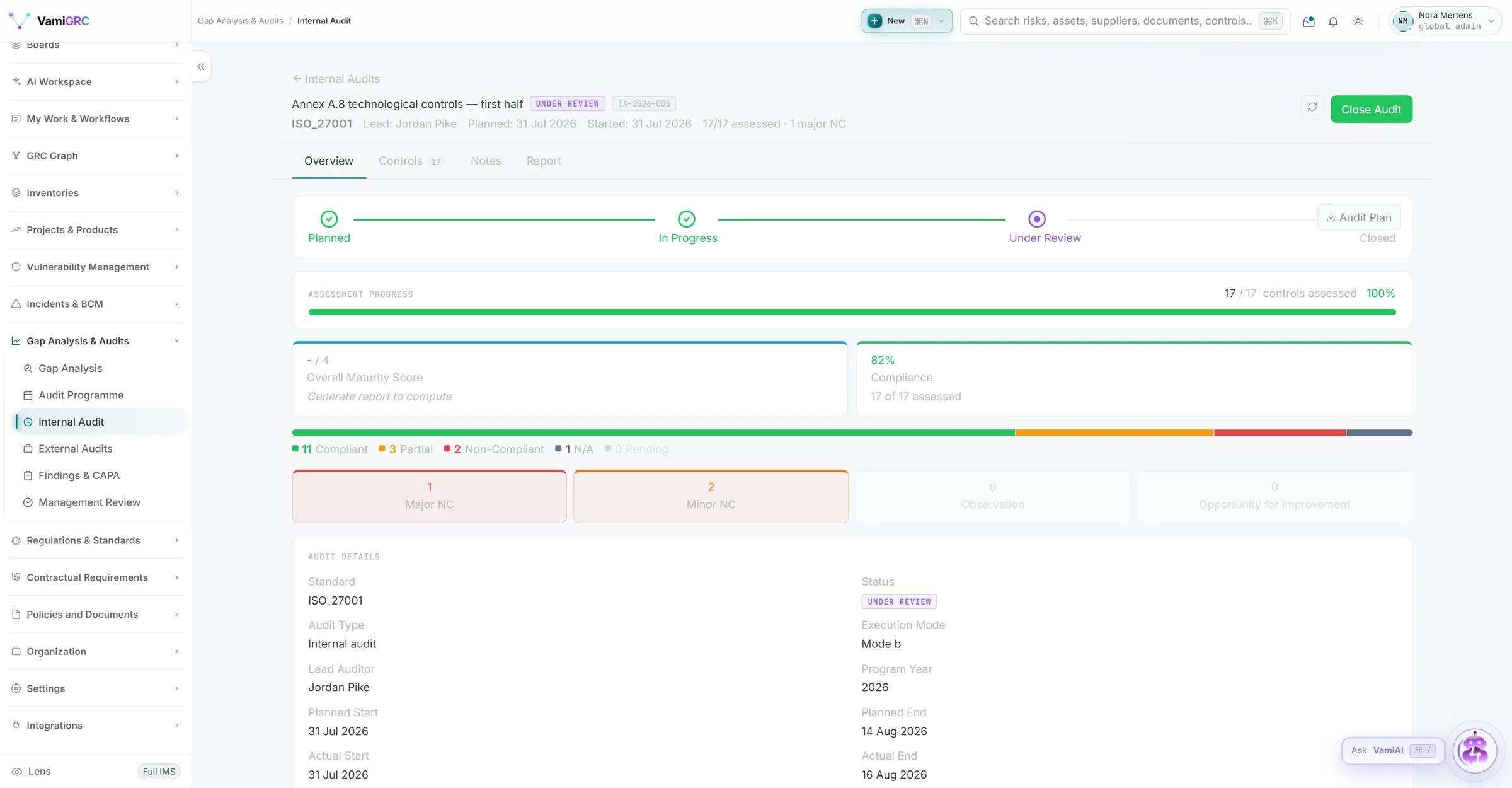
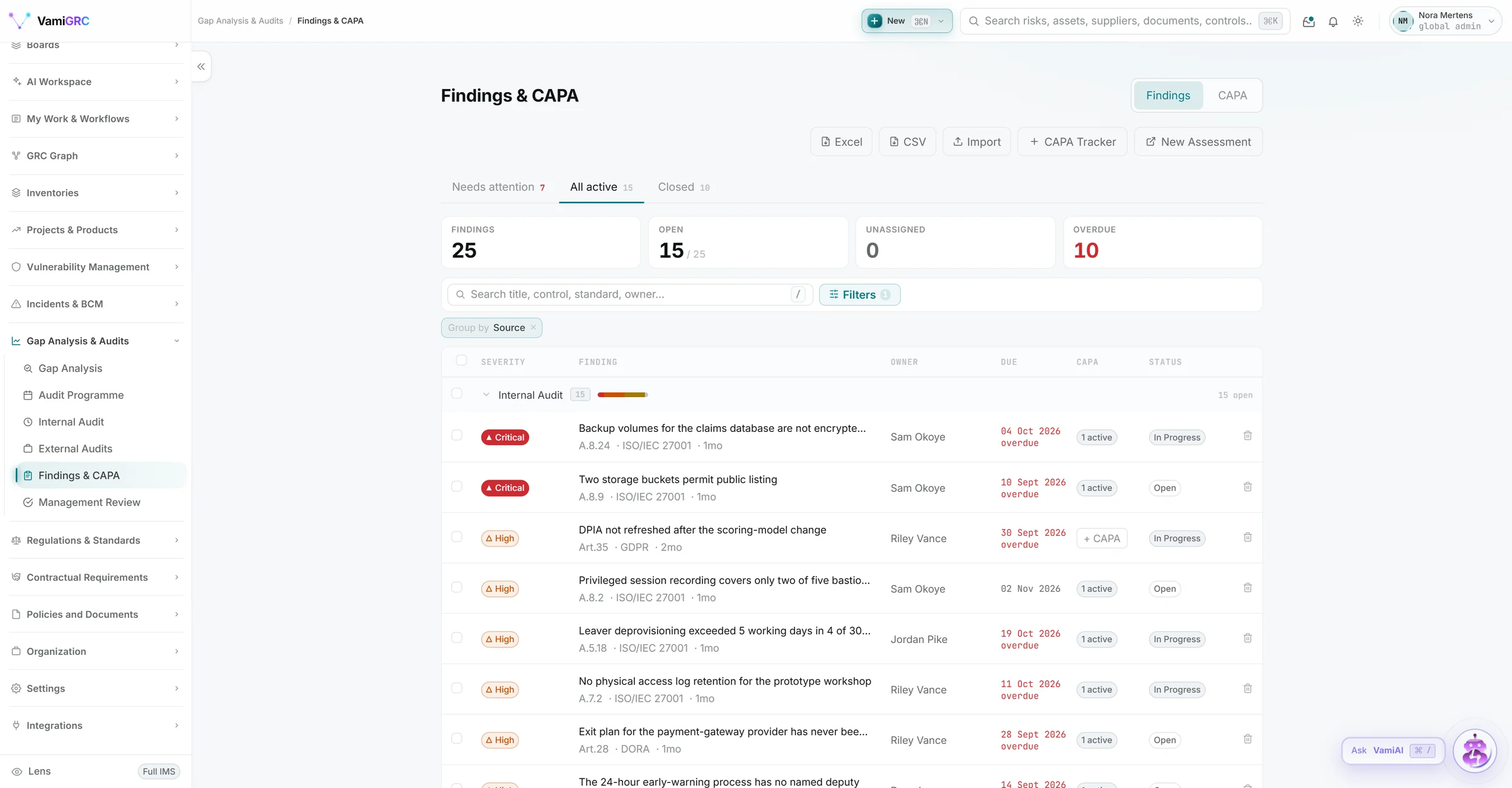
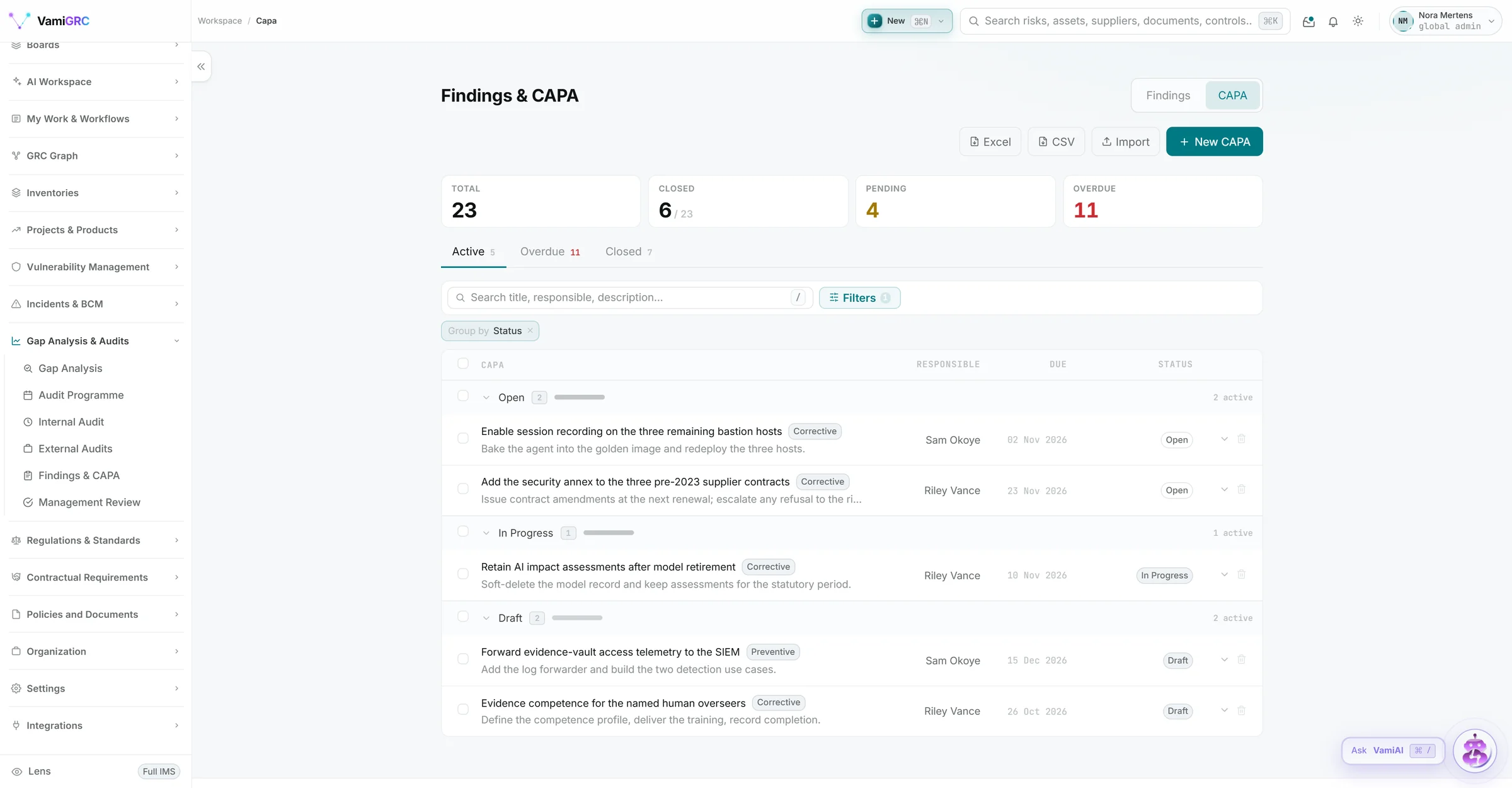
VamiAI assesses controls against your chosen standard and proposes evidence-based ratings. You confirm the results. Gaps are tracked as findings and CAPA actions.
VamiAI assesses controls against the chosen standard, pulls evidence from the IMS and proposes a rating with justification — human in the loop: every assessment is confirmed or corrected by you before it counts. Gaps become findings, findings become CAPA actions.
The versioned library holds policies, SOPs, process descriptions, concepts and evidence. VamiAI uses the RAG knowledge base to answer questions with page-level source references.
Policies, SOPs, process descriptions, concepts and evidence live versioned in the library — and are automatically indexed into a RAG knowledge base. VamiAI answers questions from them in natural language, cited down to the page.
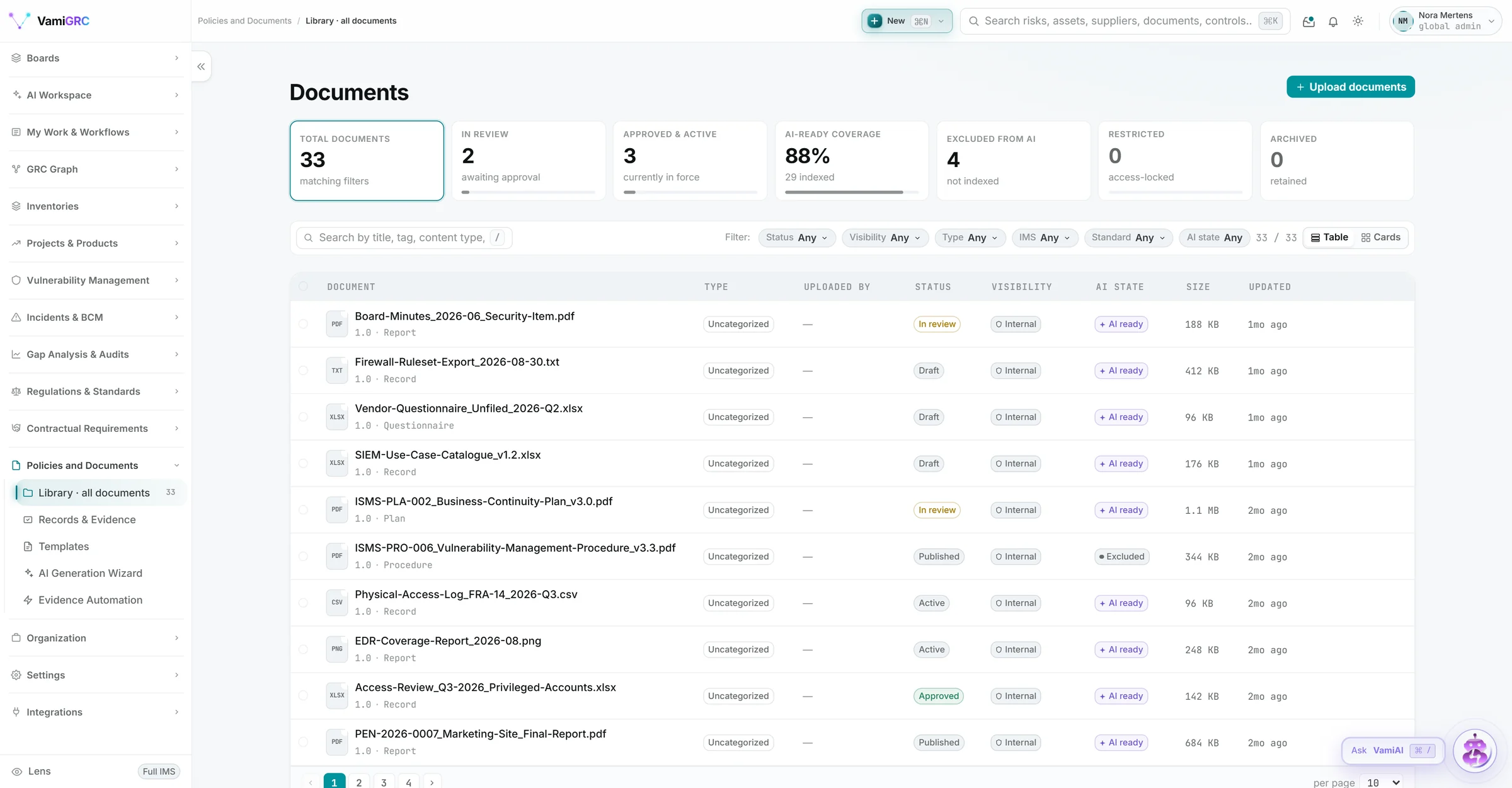
VamiAI classifies documents into twelve categories and five domains. OSCAL controls link the same evidence to the SoA, RoPA, risk register, BIA and audit package, accessible through chat, Teams or API.
Upload once. VamiAI classifies, links to OSCAL controls, and surfaces every document where it belongs — in the SoA, the RoPA, the Risk Register, the BIA, the audit packet. Same docs, queried via chat (VamiAI · Microsoft Teams · API).
Information security, access control, passwords, clean desk.
Incident, change, on/offboarding, backup.
Control applicability, justification, status.
Risk register, methodology & treatment plan.
SIRT and role matrices (RACI).
Asset inventory and Business Impact Analysis.
Service providers, partners, authorities.
Internal audit reports and findings.
Review minutes and decisions.
Risk treatment / action plans & owners.
Endpoint hardening, network security, passwords.
Materials and attendance evidence.
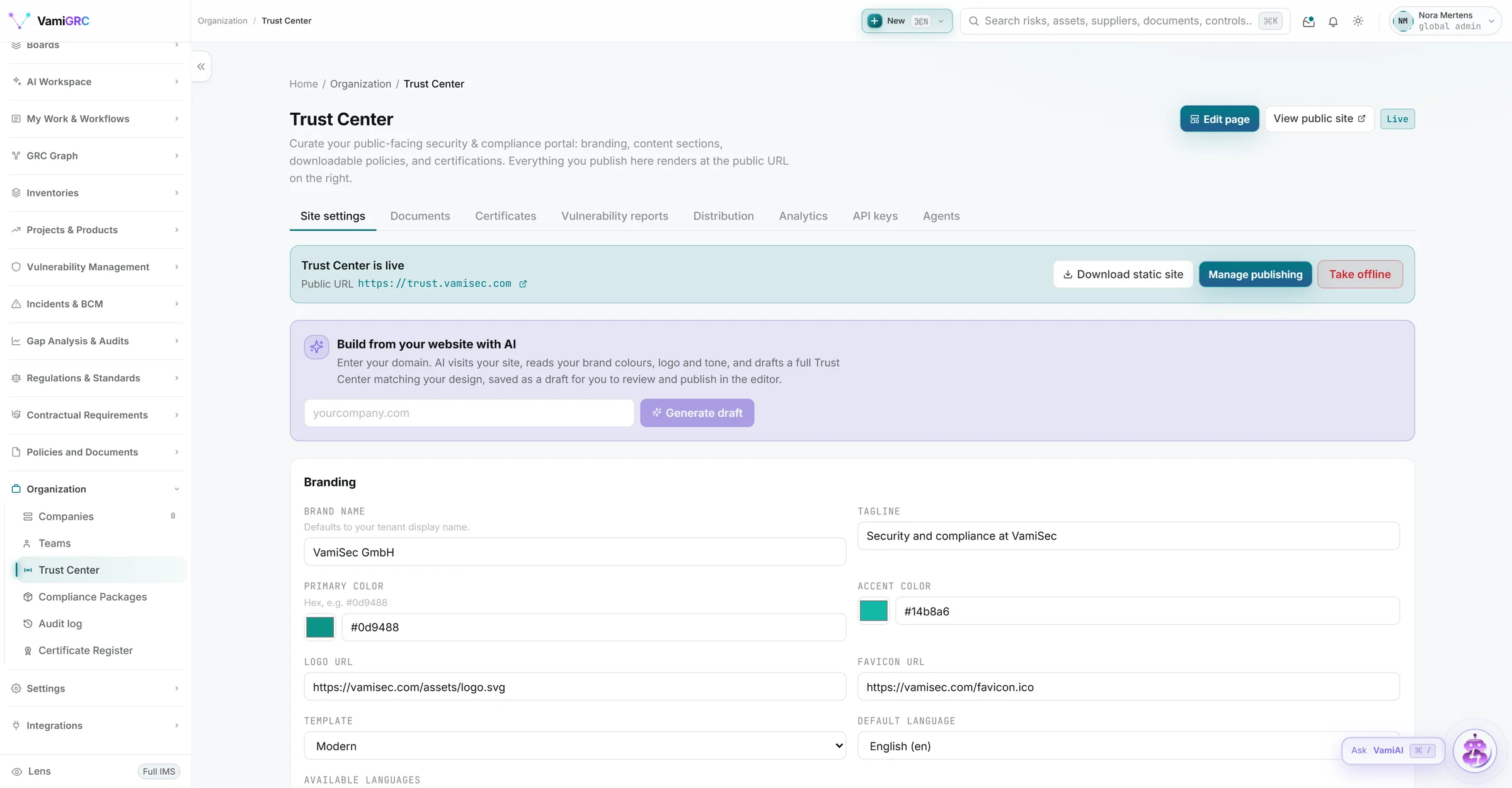
Build your public trust centre and framework-specific compliance packages from existing IMS data. Evidence stays linked to its operational context.
Your public trust center and curated compliance packages per framework are built from the same data you work with anyway. Proving compliance stops being a project and becomes a by-product of operations.
200+ questions: from two working days to five minutes.
VamiAI uses classified and mapped IMS documents to answer customer and insurance questionnaires. Each response includes supporting evidence.
Customer security questionnaires. Insurance partner assessments. 200+ questions about your ISMS, AIMS and BCMS. Normally: 2 working days of compliance-officer copy-paste. With VamiGRC: under 5 minutes — because every answer is already in your Document Management, classified, mapped, and ready for VamiAI to reference.
Supports CSA CCM v4.1 · CAIQ · SIG · VSAQ · custom XLSX/JSON. Cited evidence per answer · audit-grade · exportable for the requestor.
Pentests, scans, reports and threat feeds land in one register. Findings are prioritised by asset criticality and tracked through to retest.
Asset criticality, KEV and EPSS guide prioritisation. CACS classification connects incidents to relevant NIS2, DORA, CRA, AI Act, NCCS and NIS-AI reporting paths.

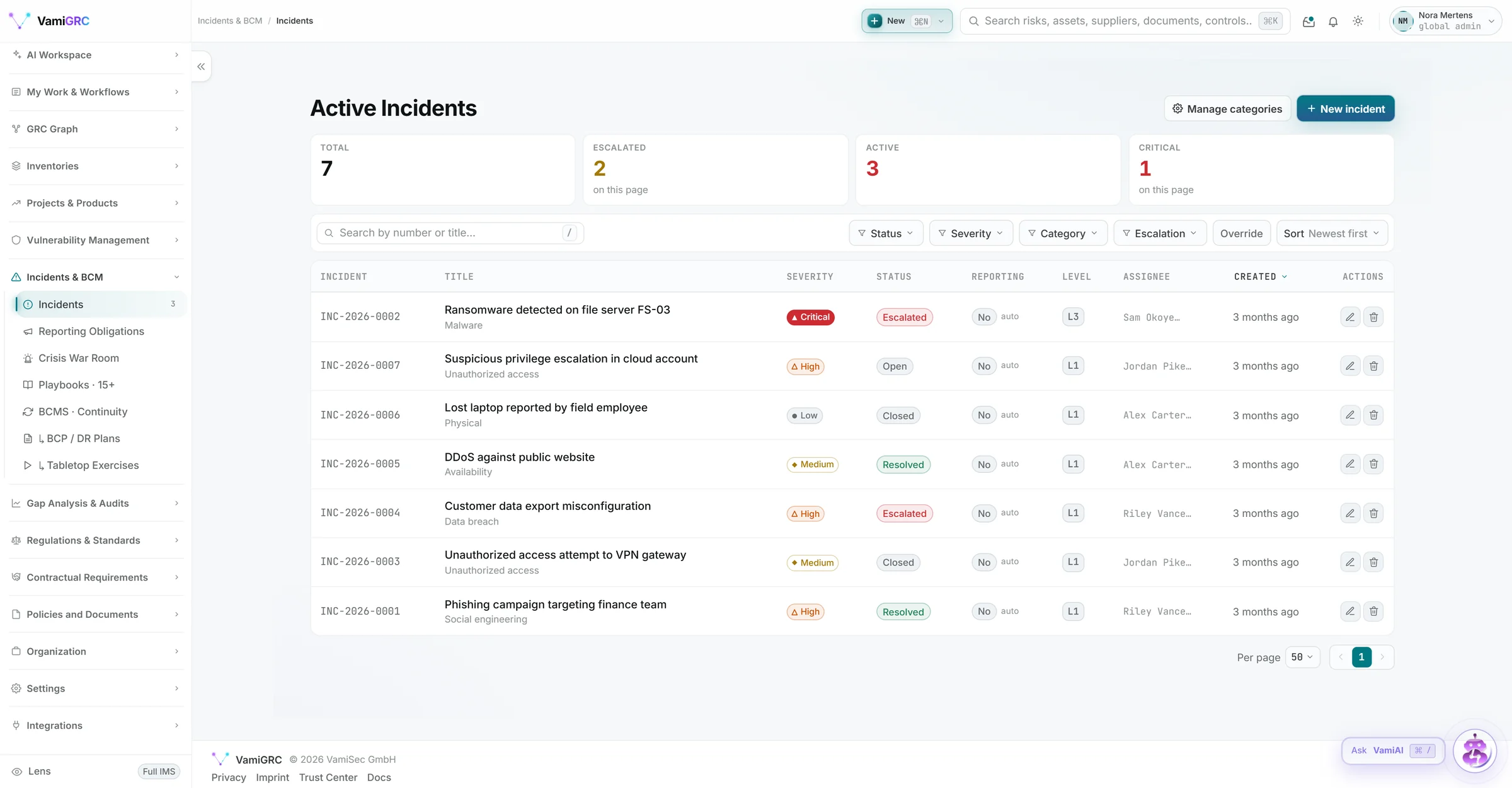
Findings prioritised asset-first by criticality, KEV signals, EPSS, NIS2/CRA notification windows. Incidents classified once via the CACS engine (Cyber Attack Classification Scale) — automatic mapped reporting drivers for NIS2 · DORA · NCCS · AI Act · NIS-AI.
Pentests, scans and reports feed one register. Each remediation plan includes an owner, deadline and retest evidence. VamiAI supports prioritisation and mitigation planning.
Pentests, scans and reported vulnerabilities come together in one register. Every finding gets a remediation plan, an owner, a deadline and retest evidence; workflows automate the follow-up, and VamiAI suggests prioritisation and measures.
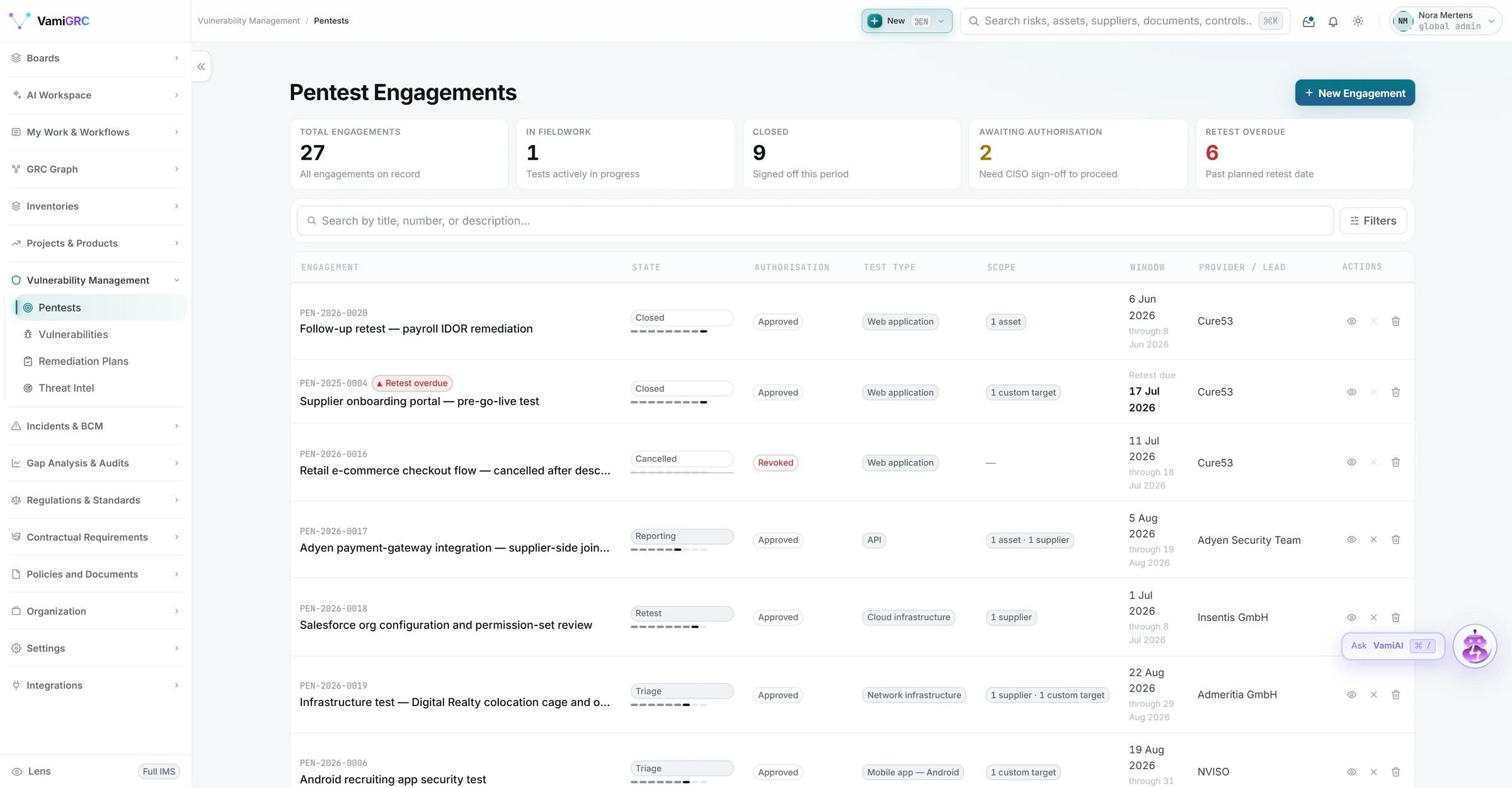
Start pentests from projects, assets or a standalone engagement. Keep authorisation, scope and evidence documented. Findings enter the shared vulnerability inventory with VPS scoring and SLAs.
Pentests originate from projects (auto on Build & Test or Go-Live), from assets (recurring per criticality), or as standalone (TLPT-DORA · KRITIS · bug-bounty). Every engagement carries a signed Letter of Authorisation · scope is frozen post-authorisation · evidence is chain-of-custody-tracked. Findings flow into the unified Vulnerability Inventory with VPS scoring and SLA-based remediation.
Auto-triggered on Build & Test or Go-Live phase-gate when SEC-01 is in scope. Scope = linked project assets. Open Critical / High findings hard-block Go-Live.
Manual ("Plan Pentest" button on every asset) or scheduled per criticality: Critical 6 m · High 12 m · Medium 24 m · Low 36 m · or on-change. Refreshes last_pen_test_date.
Ad-hoc red team · regulatory mandate (TLPT-DORA · KRITIS · NIS2) · bug-bounty triage · M&A due-diligence. Custom scope · linked to Legal Register entry.
Specialised pentest engines that orchestrate via the VamiRed dispatcher. Hard stops on out-of-scope, DoS, unauthorised SE, real PII exfil, change-freeze — only re-authorisation can unblock.
VDP, CVD and bug bounty connectors combine submissions as unified vulnerability reports. They share VPS scoring, SLAs and the risk register. Payouts stay on the respective platforms.
Unified pipeline for the entire vulnerability-disclosure trifecta: anonymous public reports (VDP), coordinated disclosure (CVD · ISO 29147 + 30111), and bug-bounty connectors for the four major EU/US platforms. Every inbound report becomes a Unified Vulnerability Report (UVR) that joins the central Findings inventory — same VPS, same SLA, same Risk Register. Bounty payouts remain platform-native (AML/compliance). Hash-sealed audit trail with daily eIDAS RFC 3161 qualified-timestamp signature.
White-label public CVD portal · RFC 9116 security.txt auto-renewed · anonymous OK · PGP optional. Anonymous reporting supported — aligned with the CVD process under NIS2 Art. 12.
REST v2 · OAuth2 Client Credentials · native webhooks (submission.created/.updated/.messaged/.closed). EU residency.
REST + PAT · field-mapping via ywh2bugtracker · EU residency. Phase 1 priority alongside Intigriti.
REST v1 · Basic Auth · Lucene filters · 600 req/min. Bugcrowd Crowdcontrol REST · P1–P5 priority scale.
Same VPS (CVSS × asset criticality × exposure × EPSS × KEV), same SLA matrix, same Risk Register entries, same auto-remediation L1–L3. Click a UVR to see its source platform, researcher, AI activity log, audit trail; click a Finding to see its UVR origin.
Payments stay on HackerOne · Intigriti · YesWeHack · Bugcrowd. VamiGRC handles the vulnerability lifecycle (intake → triage → fix → disclosure → CRA reporting) and the safe-harbor clause in your policy. Hall of Fame is opt-in, researcher-consent-gated.
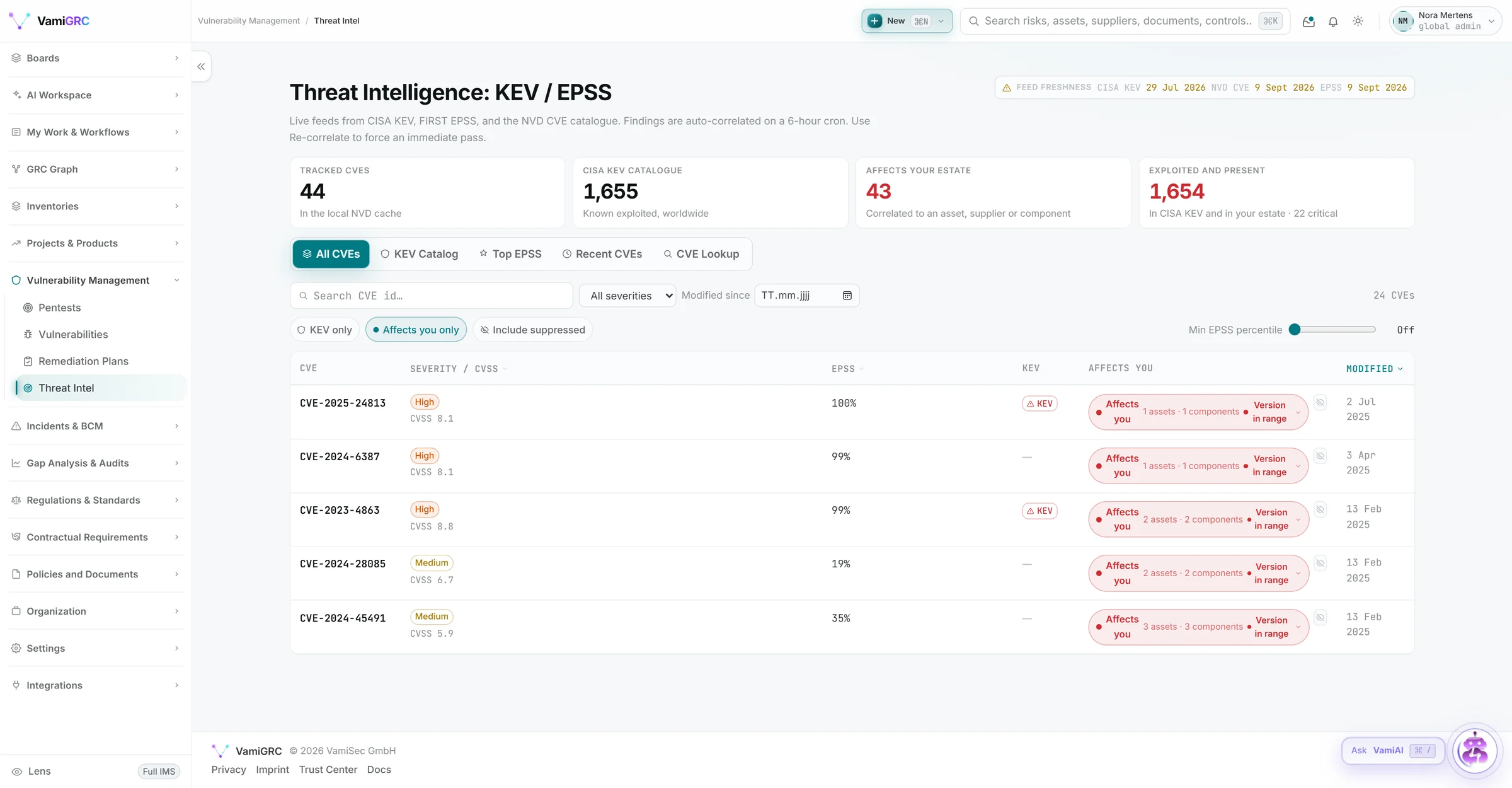
Match CISA KEV, NVD and EPSS against your assets, products and SBOMs. Affected components, KEV status and exploitation probability support prioritisation.
CISA KEV, NVD and EPSS arrive as live feeds and are reconciled against your assets, products and SBOMs. Instead of 380,000 CVEs you see the ones that actually affect you — with exploitation probability and KEV flagging for prioritisation.
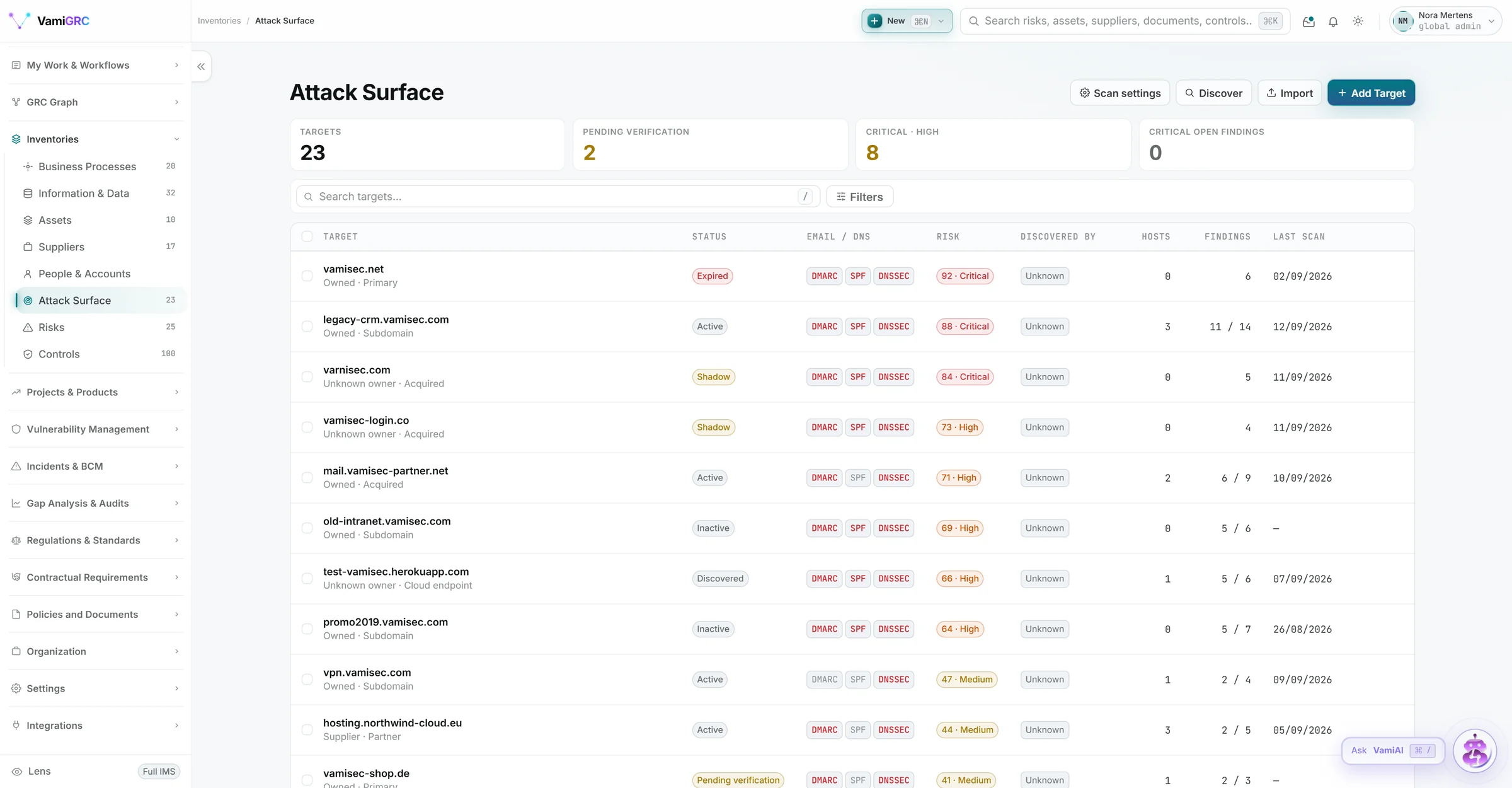
VamiRedteam checks domains and hosts for DNS security, security headers, TLS, DKIM/DMARC and exposed services. Findings map to ISO 27001 controls and NIS2 requirements.
VamiGRC continuously probes domains and hosts from the outside: DNS security, security headers, TLS expiry, DKIM/DMARC and exposed services — every finding mapped directly to ISO 27001 controls and NIS2 articles. Powered by VamiRedteam, our agentic red teaming platform.
Synchronise users, service accounts and Azure app registrations from Entra ID, Google Workspace and HR systems. Least-privilege assessments and app findings feed the risk register.
Shared data source for human users, service accounts, and Azure App Registrations — synchronised continuously from Azure Entra ID, Google Workspace and HR systems (SAP SuccessFactors, Personio, Workday). Continuous Least-Privilege Assessment. App-Reg security findings flow straight into the central Risk Register.
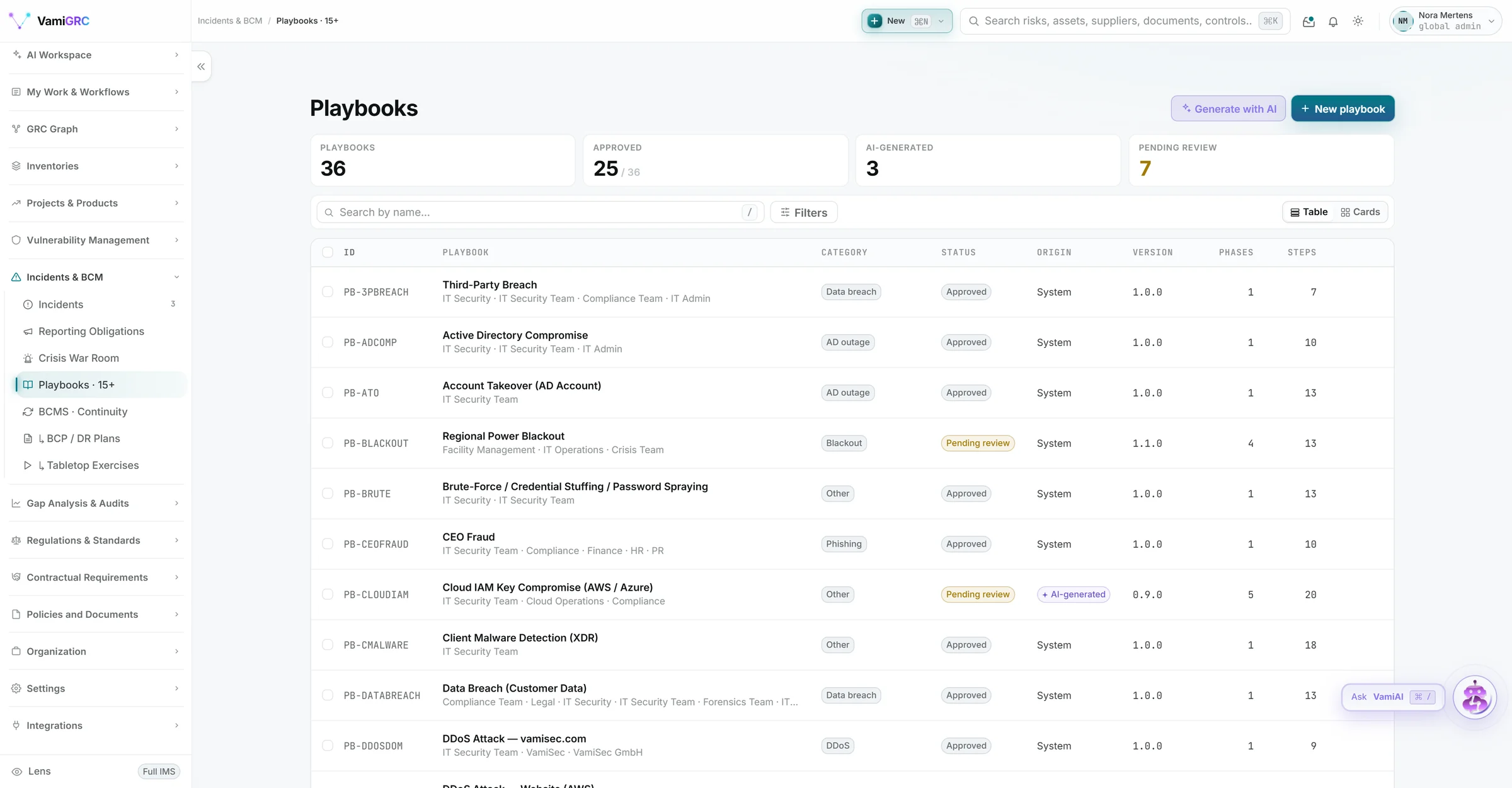
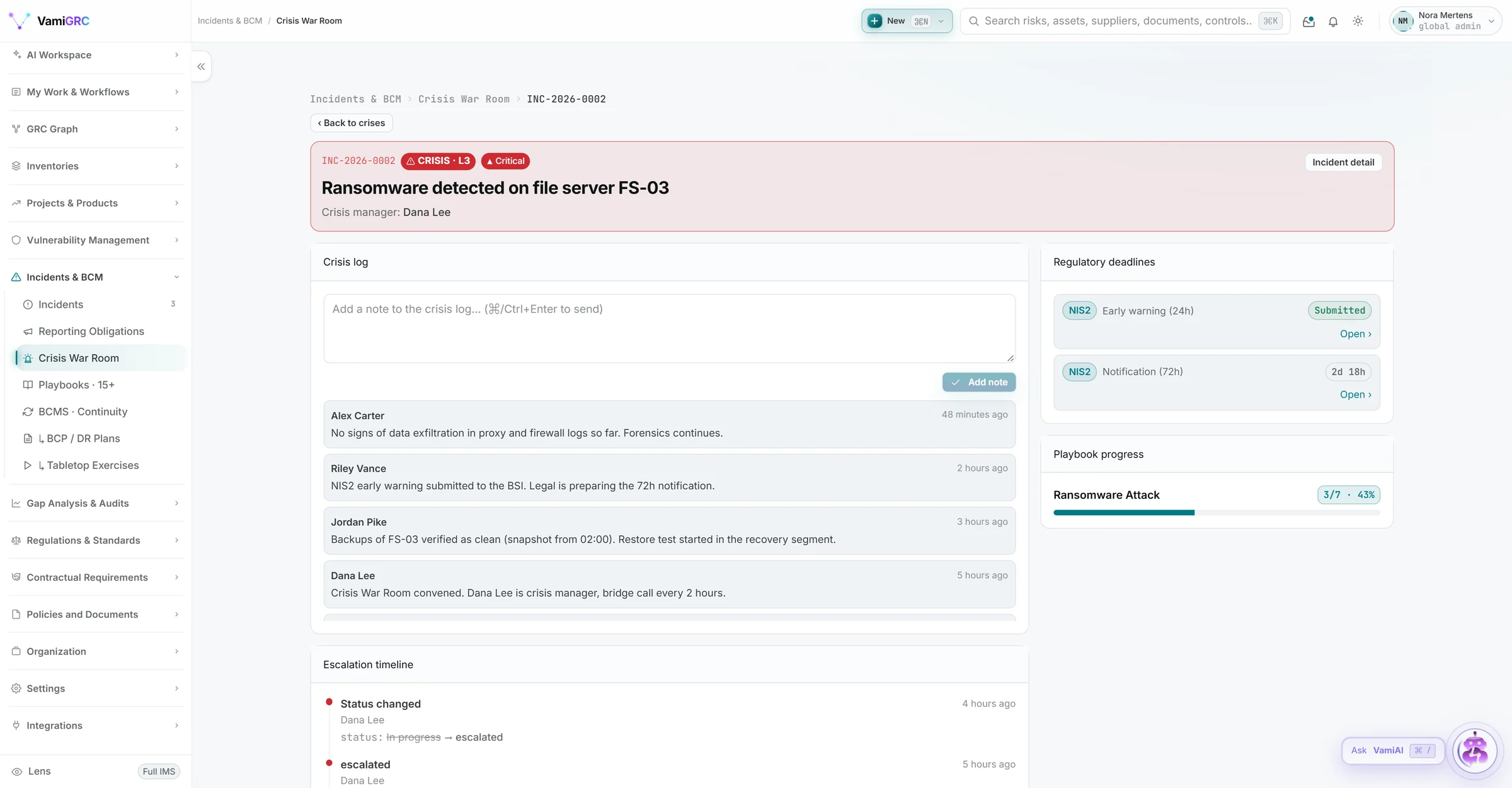
Classify incidents, run playbooks and track deadlines under NIS2, GDPR, DORA, the CRA and the AI Act. BCM plans and exercises live in the same IMS.
Logging an incident starts the relevant reporting workflows. VamiGRC guides classification, notifications and deadlines for NIS2, GDPR, DORA, CRA and the AI Act.
NIS2: 24 h early warning. GDPR: 72 h notification. DORA, CRA, AI Act: each with their own clock. VamiGRC's Incident Management module starts every clock automatically the moment an incident is logged — and walks you through every regulatory obligation, every notification, every stakeholder.
IncidentEngine pushes severity + affected processes into BCMS. BIA pulls MTPD / RTO / RPO from the linked assets. TabletopEngine reuses the same playbook for tabletops. Continuity-strategy switches are evidence-bound.
When a Tier-1 asset is impacted, IncidentEngine activates the DRP runbook. Recovery steps are tracked against RTO. Failover/failback is logged as evidence. DR test = real test = same machinery.
Incidents, BCM exercises, and DRP plans share the same data model, the same playbook engine, the same regulatory deadlines — connected to the assets, processes and suppliers in the GRC Graph. Test recovery once → satisfy ISO 22301, NIS2 BCM provisions and DORA at the same time.
Capture, classification, escalation and assignment follow a documented process. VamiAI drafts reports, while predefined and custom playbooks guide the response.
Every incident follows the same path: capture, classification, escalation and assignment — with VamiAI report drafts and a complete audit trail for every decision. Predefined playbooks built on best practices and VamiSec expertise guide the team step by step — custom ones are freely modelled.
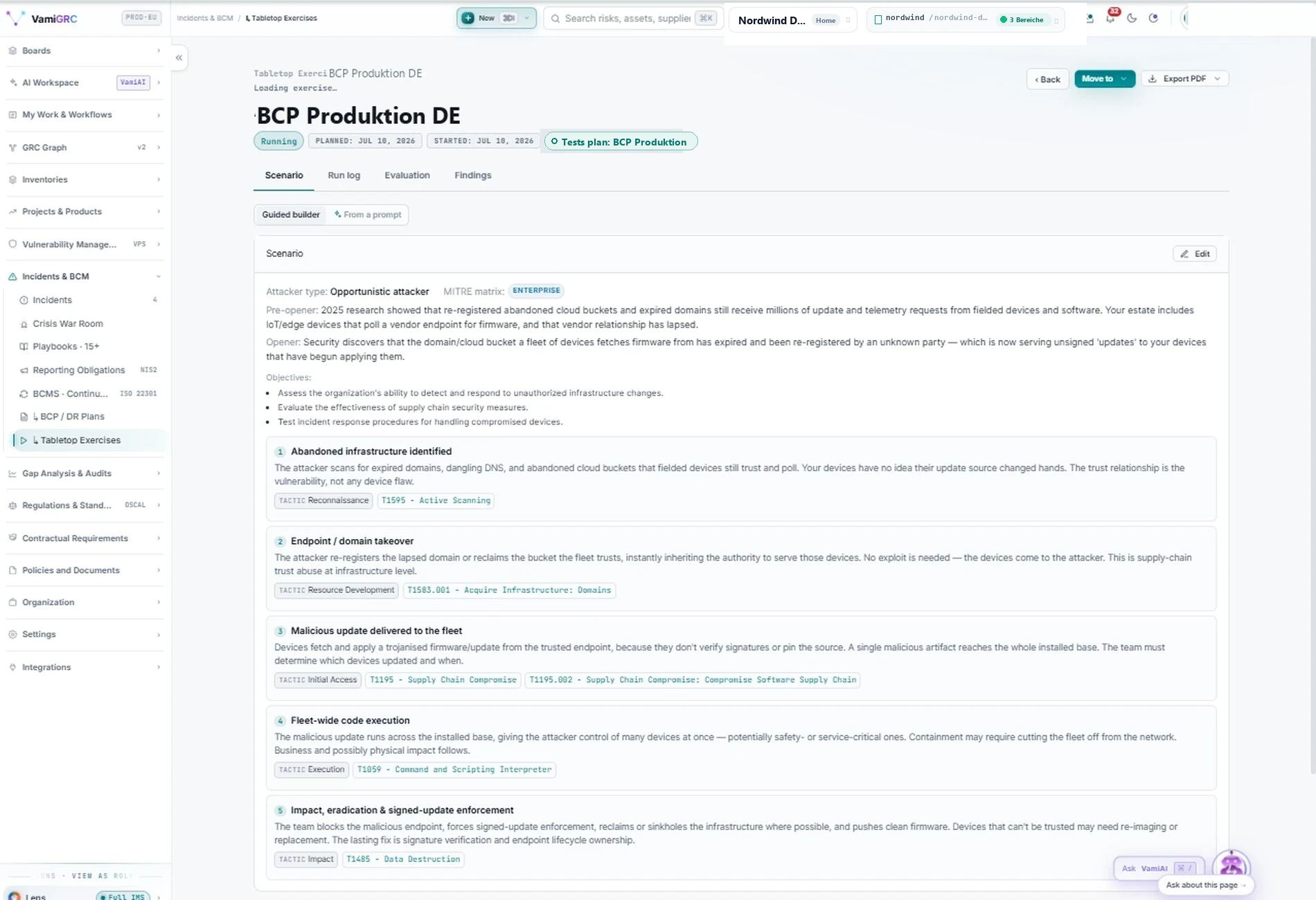
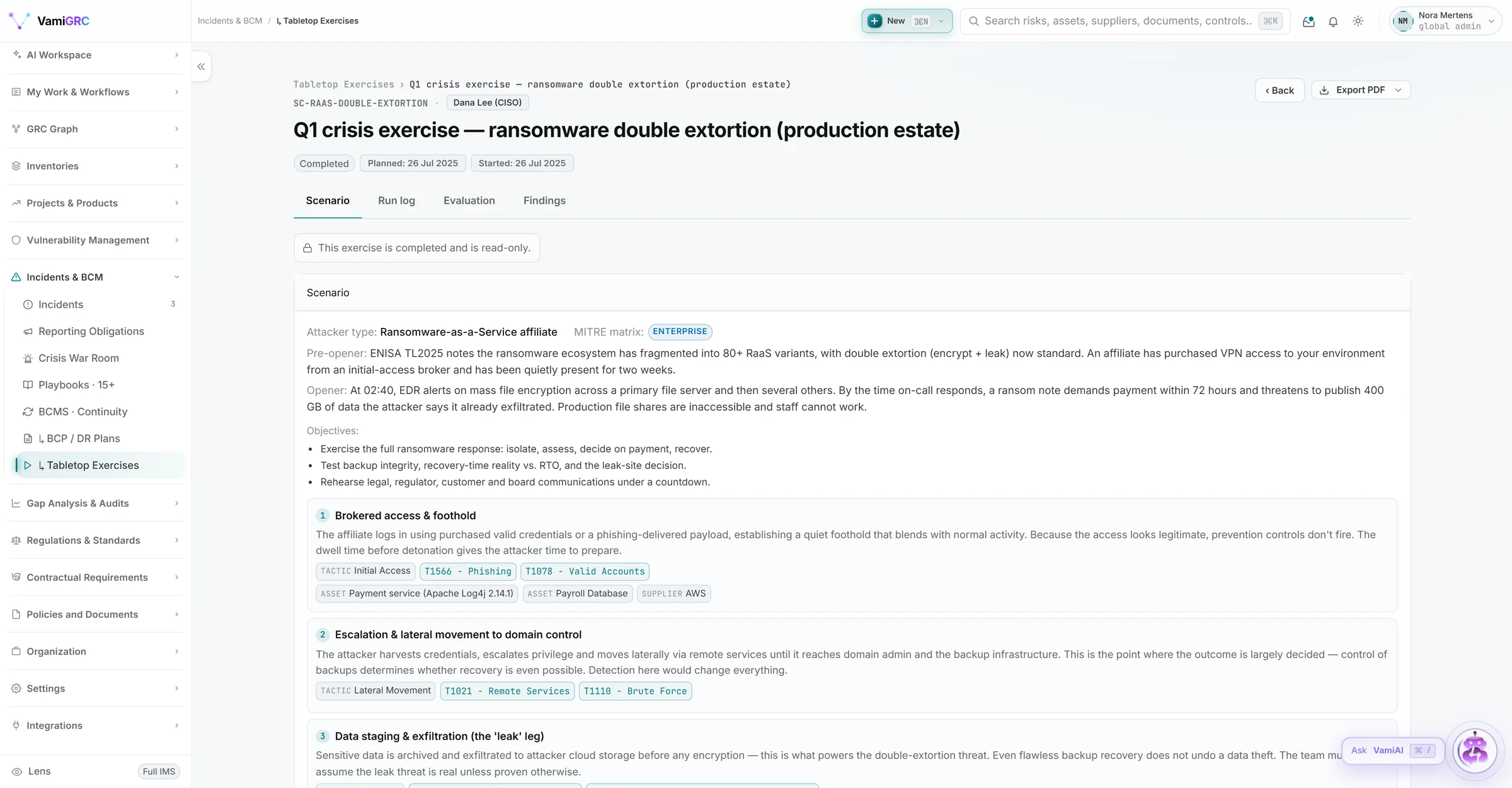
BCP and DR plans based on ISO 22301 connect recovery targets, crisis teams, critical processes and fallback strategies. Tabletop exercises and DR tests document rehearsals.
Business continuity and DR plans are built to ISO 22301 — from purpose and recovery targets through activation and crisis team to critical processes and fallback strategies. And because a plan is only as good as its last test, DR tests and tabletop exercises are part of the package.
KPIs are calculated from IMS data. The Champion Center shows GRC maturity per module and makes participation visible.
More than 40 operational metrics across five IMS domains track progress. Define additional KPIs with graph queries and attach them to evidence.
40+ pre-built operational metrics across 5 IMS domains, plus any KPI you define yourself. Translate plain English into a graph query, surface the data, attach to evidence.
Compliance adoption is gamified. Each platform module earns badges per usage: complete onboarding, configure routinely, climb achievements, climb the leaderboard — build pride in your compliance culture.
Badges, onboarding steps and a leaderboard recognise how teams use and develop each module.
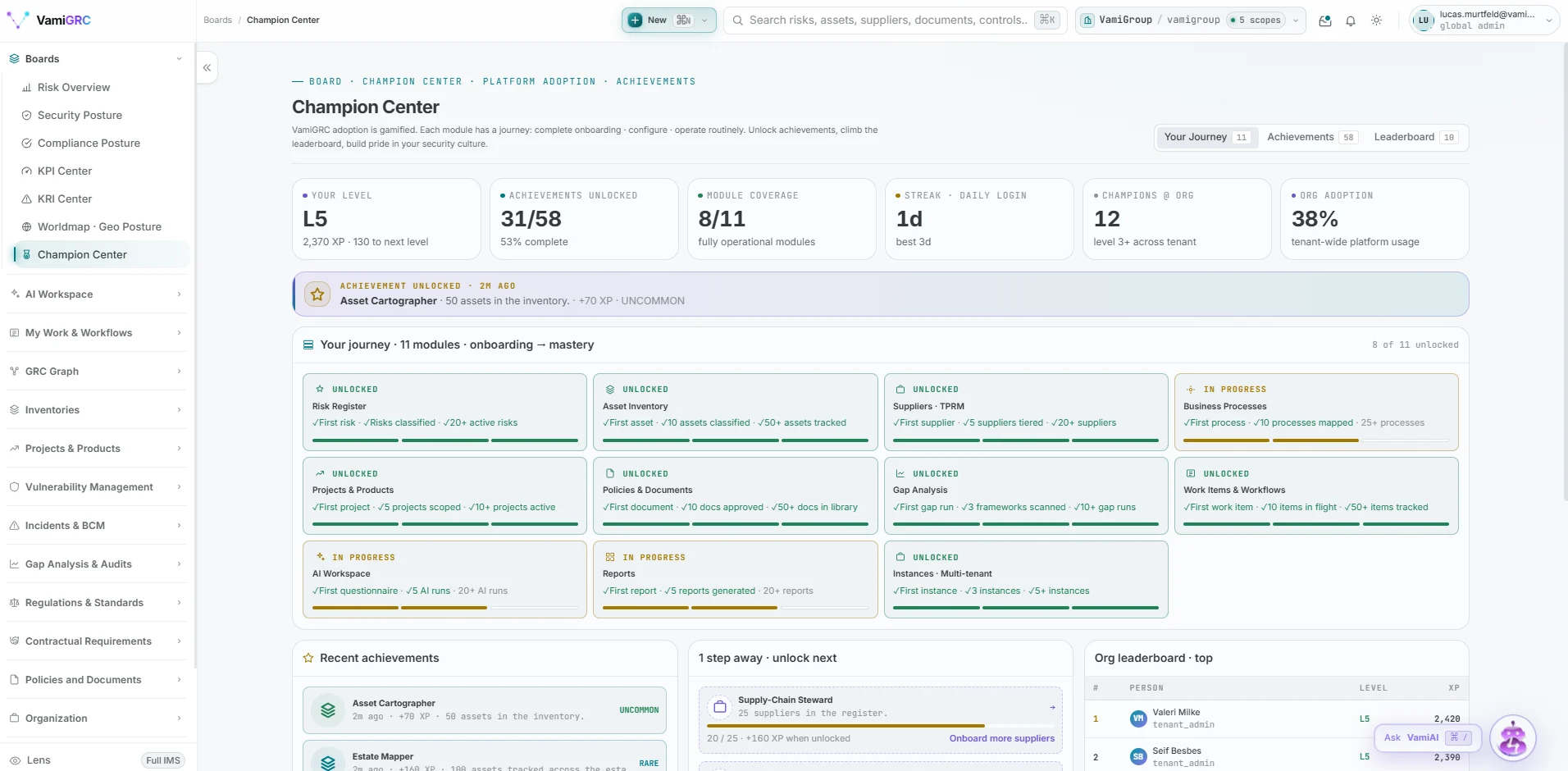
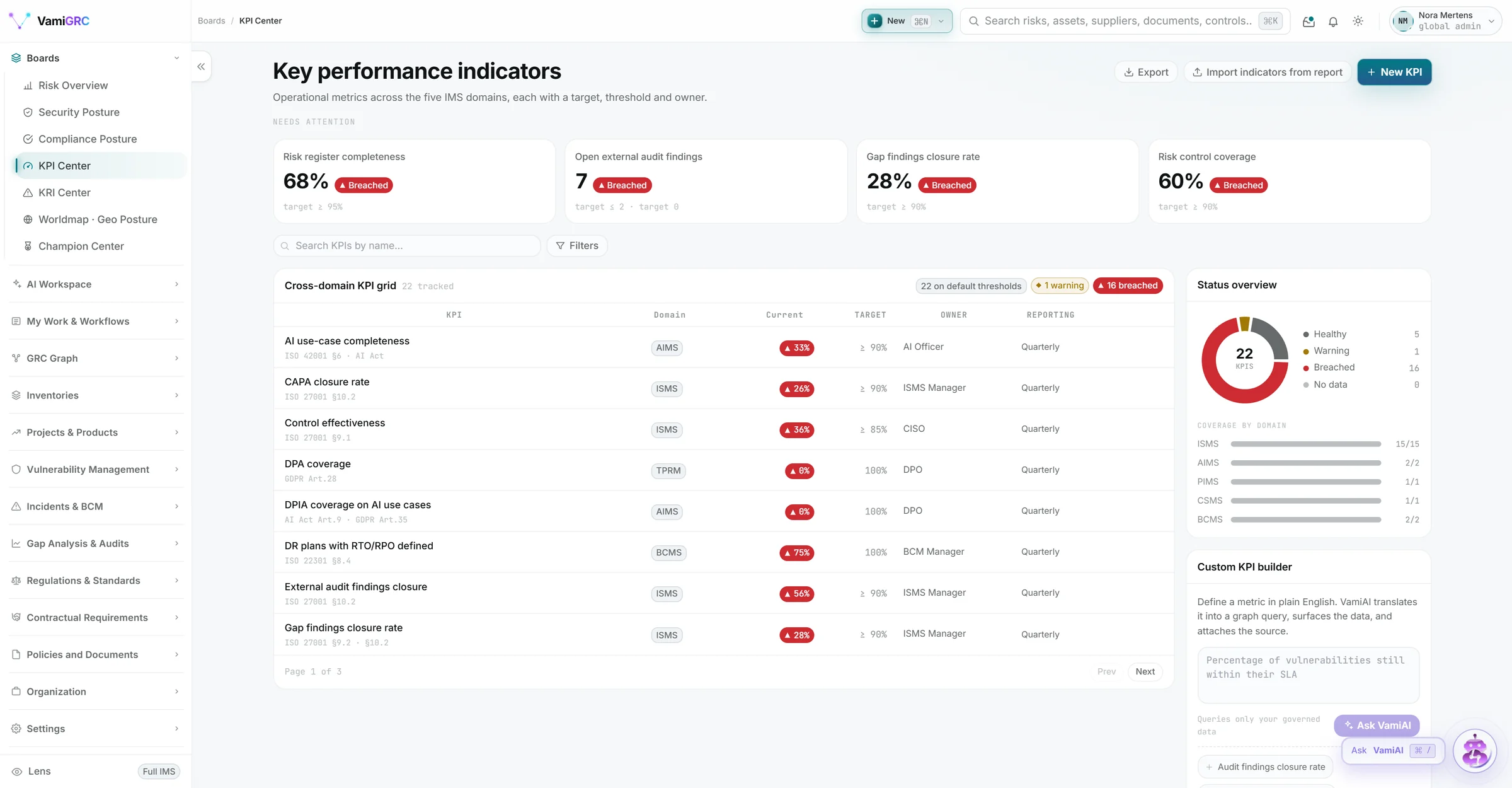

The KPI centre calculates metrics across IMS domains from live data. Each KPI has a target, threshold, owner and reporting path.
The KPI Center computes operational metrics across all IMS domains from your live data — each with a target, threshold, owner and reporting path. No manual reporting, no spreadsheet upkeep.
The champion centre tracks each module from onboarding to advanced use. Gamification recognises achievements and continued participation.
The Champion Center makes the maturity of your GRC implementation measurable: every module has a journey from onboarding to mastery. At the same time it rewards the people who keep the system alive — gamification that builds real security culture.
Developed in Sankt Augustin and built around German cloud infrastructure. AI provider configuration, certifications and audit evidence are documented transparently, including for regulated industries.
 VamiSec GmbH · ISMS
ISO/IEC 27001:2022 certified
Certificate DE-IS-20250191 · Proks Certification (DAkkS-accredited) · valid until 18 Sep 2028 · view certificate ↗
 Hosting · Deutsche Telekom
Hosted on T Cloud Public
German data centres in Biere/Magdeburg · BSI C5 Type 2 attestation of the platform · details in the Trust Center ↗
Built for the regulated industries — banks, insurers, hospitals, energy, defence. Data processed in the EU by default — third-party LLMs are optional and can be disabled per tenant. Immutable audit log. Lead-Auditor expertise built into the team.
VamiGRC's agent layer is provider-agnostic. Default to Anthropic Claude · swap in OpenAI · route sensitive data exclusively to a local LLM in VamiSec’s German data centre · or bring your own via any OpenAI-compatible endpoint (vLLM · Ollama · Bedrock · Vertex). One config change. Zero code.
DEFAULT
Best reasoning quality for risk analysis, gap assessment, regulatory interpretation · 200 K context.
Embeddings for semantic search and selected special functions · GPT models answer until the switch to Claude is complete.
For KRITIS · NIS2 · DORA · public sector. Runs in VamiSec’s own data centre in Sankt Augustin — prompts never leave Germany.
Any OpenAI-compatible endpoint · on-prem (vLLM · Ollama) · private Azure OpenAI · AWS Bedrock · GCP Vertex AI · HF TGI · air-gapped.
Risk analysis · multi-framework gap assessment · pentest extraction · toxic-combo narrative · regulatory interpretation.
Asset classification · framework mapping · evidence suggestion · CAIQ answering · KPI calculation · CIA assessment.
Deduplication · normalisation · tag suggestion · severity classification · SLA calc · bulk enrichment.
Connect any model exposing an OpenAI-compatible /v1/chat/completions endpoint. Auto-validation on connect: connectivity · auth · model probe · structured output · p50/p95/p99 latency.
Hybrid mode: tasks touching PII / classified data auto-route to the sovereign provider — everything else stays on the default engine.
Keycloak JWT validation per request. Customer-managed keys (CMK / BYOK). No cross-tenant access by design — verified by independent pen-test.
Append-only · timestamped · cryptographically chained · evidence-grade. Exportable for regulators as OSCAL assessment-results JSON.
ISO 27001 + ISO 42001 Lead Auditors · BSIG §8a · TISAX 6.0 Auditor · AI Officer · Data Protection Officer · trained on the spec, building the spec.

Native SAML 2.0 + OIDC integration with Microsoft Entra ID (formerly Azure AD). Conditional Access · MFA · Privileged Identity Management · group-mapped Lens roles. SCIM 2.0 user provisioning. Okta · Google Workspace · LDAP also supported.
VamiSec — the company behind VamiGRC — is itself ISO 27001:2022 certified. We don't just sell the framework — we live it. ISO 42001 (AIMS) certification in progress · TISAX 6.0 AL3 scoped · SOC 2 Type II in audit window.
Designed from day one for KRITIS operators, public administration and regulated industries. NIS2 Essential / Important · DORA · BAIT · KAIT · MaRisk · KHZG · NIS2 BSIG §30 · BSIG §8a — every obligation a first-class object in the model.


Multi-tenant model with proper hierarchy: parent → subsidiary → BU → product. Inherit policies down · roll up evidence and KPIs upward. Per-entity Lens · OSCAL profile · audit log. Cross-entity toxic-combination detection at group level.
VamiGRC is the AI-native, agentic GRC platform by VamiSec GmbH from Germany. It brings NIS2, the Cyber Resilience Act (CRA), the EU AI Act, DORA and ISO 27001 together in one integrated management system: information security (ISMS), privacy (PIMS), AI (AIMS), product cyber security (CSMS) and business continuity (BCMS) share one knowledge graph, the GRC Graph.
NIS2, the CRA, the EU AI Act, DORA and the GDPR, plus ISO/IEC 27001:2022, ISO/IEC 42001, ISO/IEC 27701, ISO 22301, IEC 62443 and other frameworks. A control is implemented once and mapped to ISO 27001, NIS2, DORA and more; the same evidence feeds the SoA, risk register and audit package.
Only as far as you allow. Four autonomy levels (L0–L3) define what runs automatically and what needs an approval. AI agents draft risk assessments, reports and notifications; your experts review and approve them, and every step is recorded in the audit log.
On T Cloud Public by Deutsche Telekom, exclusively in German data centres (Biere/Magdeburg). Enterprise customers can also run VamiGRC on their own infrastructure. You choose: models from large providers such as Anthropic and OpenAI, a local LLM in the VamiSec data centre in Sankt Augustin or, with BYOLLM, your own LLM. Third-party AI can be switched off per tenant. We never use customer data as training data.
A PIMS governs the lawful processing of personal data and makes it demonstrable. It covers the record of processing activities (RoPA), data protection impact assessments (DPIA), processor agreements, international transfers, data subject requests and data breaches, each with clear owners. A business process, its RoPA entry and, where AI is used, its AI use case can share one record, so privacy details are entered once and reused.
The BIA links MTPD, RTO and RPO to the supporting assets and sets each supplier's criticality and tier, which in turn drives recovery priorities. Incidents, exercises and DR plans share one data model and playbook engine, so one recovery test can serve as evidence for ISO 22301, NIS2 and DORA.
Yes, in Professional and Enterprise. With Bring your own LLM (BYOLLM), you configure your own model in VamiGRC. The monthly tokens then no longer matter, and we reduce the price by 20%. Together with hosting on T Cloud Public, both plans are fully EU-sovereign; as an add-on option, Enterprise can also run completely on premises.
VamiGRC pricing: free until go-live, unlimited user accounts and SSO in every plan, Professional from €4,990 per year with 20 million AI tokens a month, Enterprise on request. The price depends on the number of employees, not on the number of users. Pricing →
VamiSec lead auditors support certifications to ISO 27001, BSI IT-Grundschutz and ISO 42001 and take on GRC tasks for your team.
Yes. Employees use VamiAI in the browser, in Microsoft Teams and in Slack. The VamiGRC connector for Claude is listed in the Claude connector directory: Claude works in VamiGRC with your roles and permissions, and nothing is written without your OK.
In a 30-minute demo, we walk through a framework, its OSCAL profile and graph-based risk analysis using your scope.
The 30-minute live demo follows your scope. We show a framework mapped to an OSCAL profile and how VamiAI identifies a toxic combination in the graph.
direct slot · live calendar · no sales chase · MS Teams link by email
From 1 December: 24 doors, 24 vouchers
A voucher every day. VamiGRC is in the calendar several times: one month free, gap analyses for NIS2, CRA or ISO 27001, risk and supplier assessments.Open today’s door and redeem your voucher – until 31 December 2026.
The video loads from YouTube (Google) only after you click play. Privacy policy
Starts on 1 December 2026 · a new door every day1–24 December 2026 · redeemable until 31 December 2026
